Earlier this year, we ran the same set of buying questions through ChatGPT for a large HVAC company in the Chicago area, about a month apart. In the first run, ChatGPT named them in roughly 95% of answers. In the second run, that number fell to about 30%. Their site hadn’t changed, and the 30% that survived lined up almost exactly with the towns where they had a Google Business Profile.
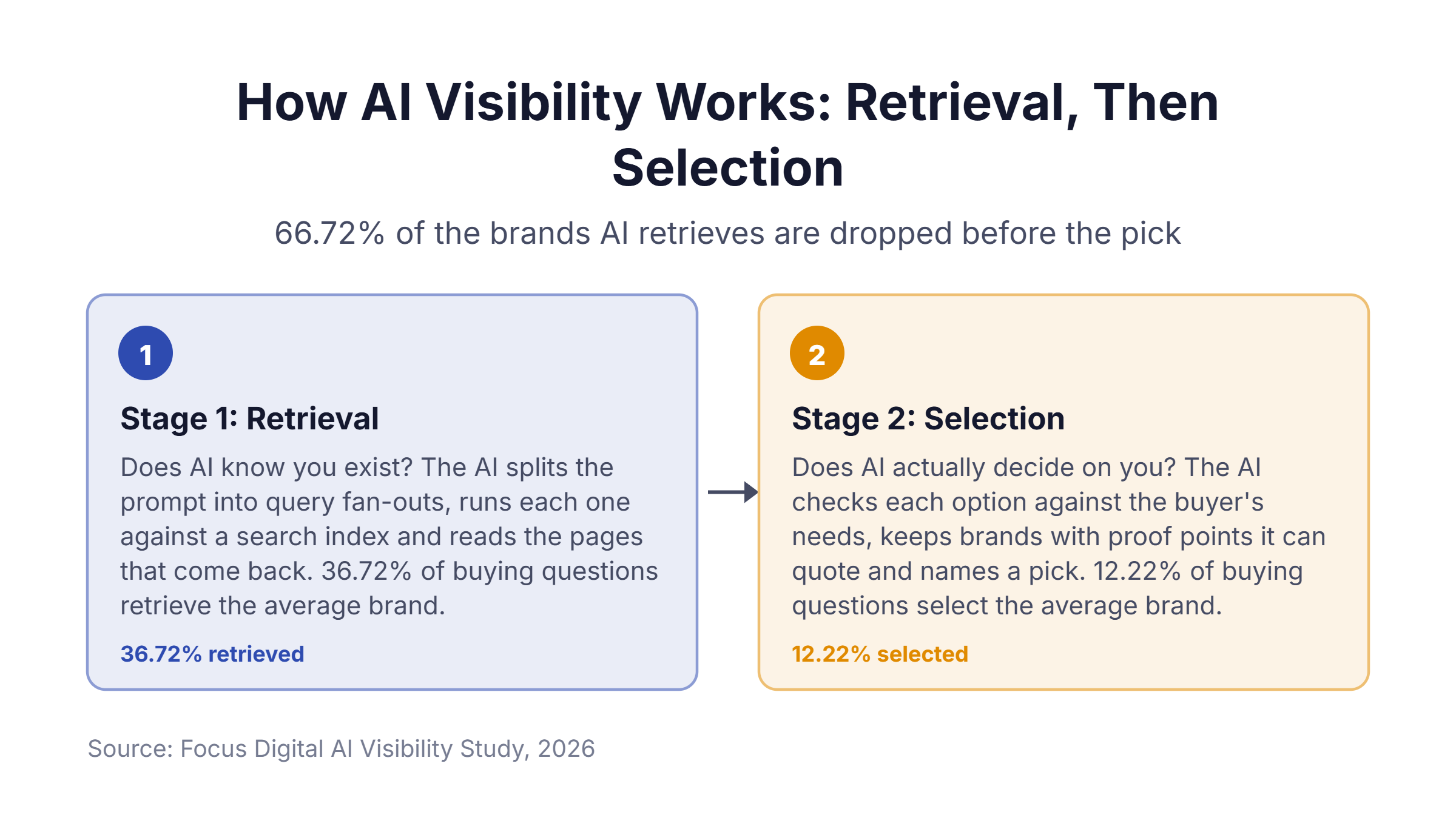
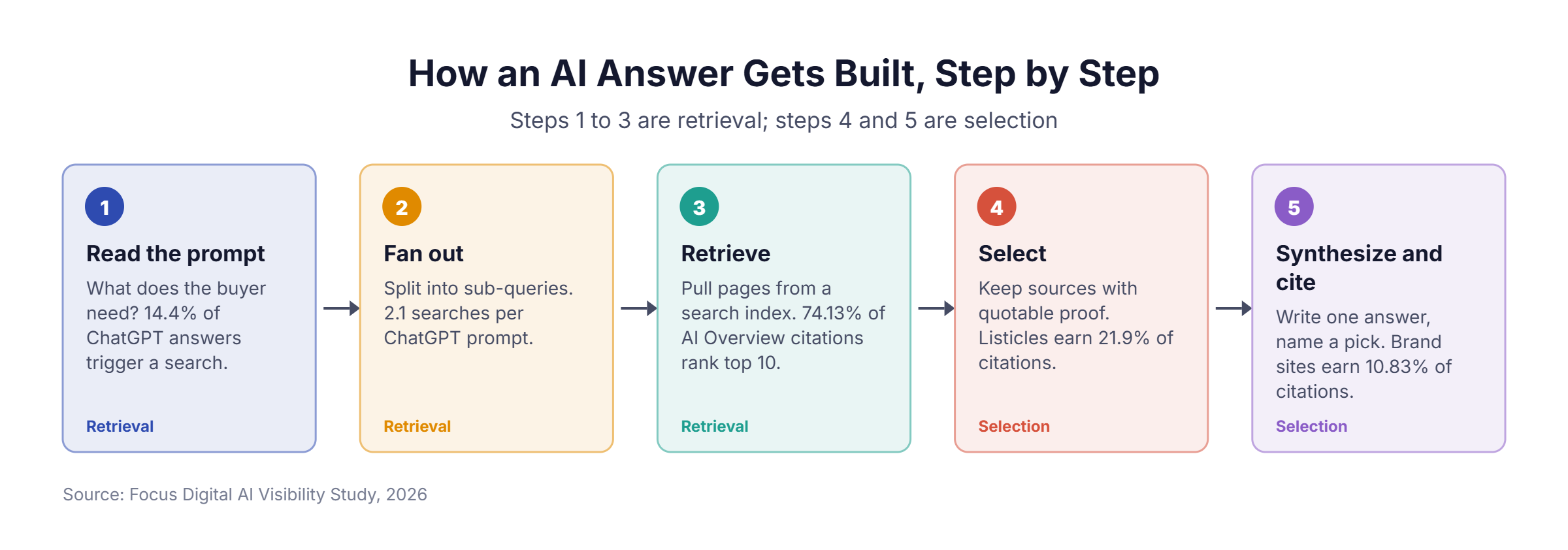
That test changed how I explain AI visibility to every client we work with. AI visibility works in two steps. First, the AI retrieves: it splits the buyer’s prompt into a set of searches, runs them against a search index, and reads the pages that come back. Then it selects: it checks each option against what the buyer asked for, keeps the sources it trusts, and names a pick. I put it to clients as two questions. Does AI know you exist? Does it actually decide on you?
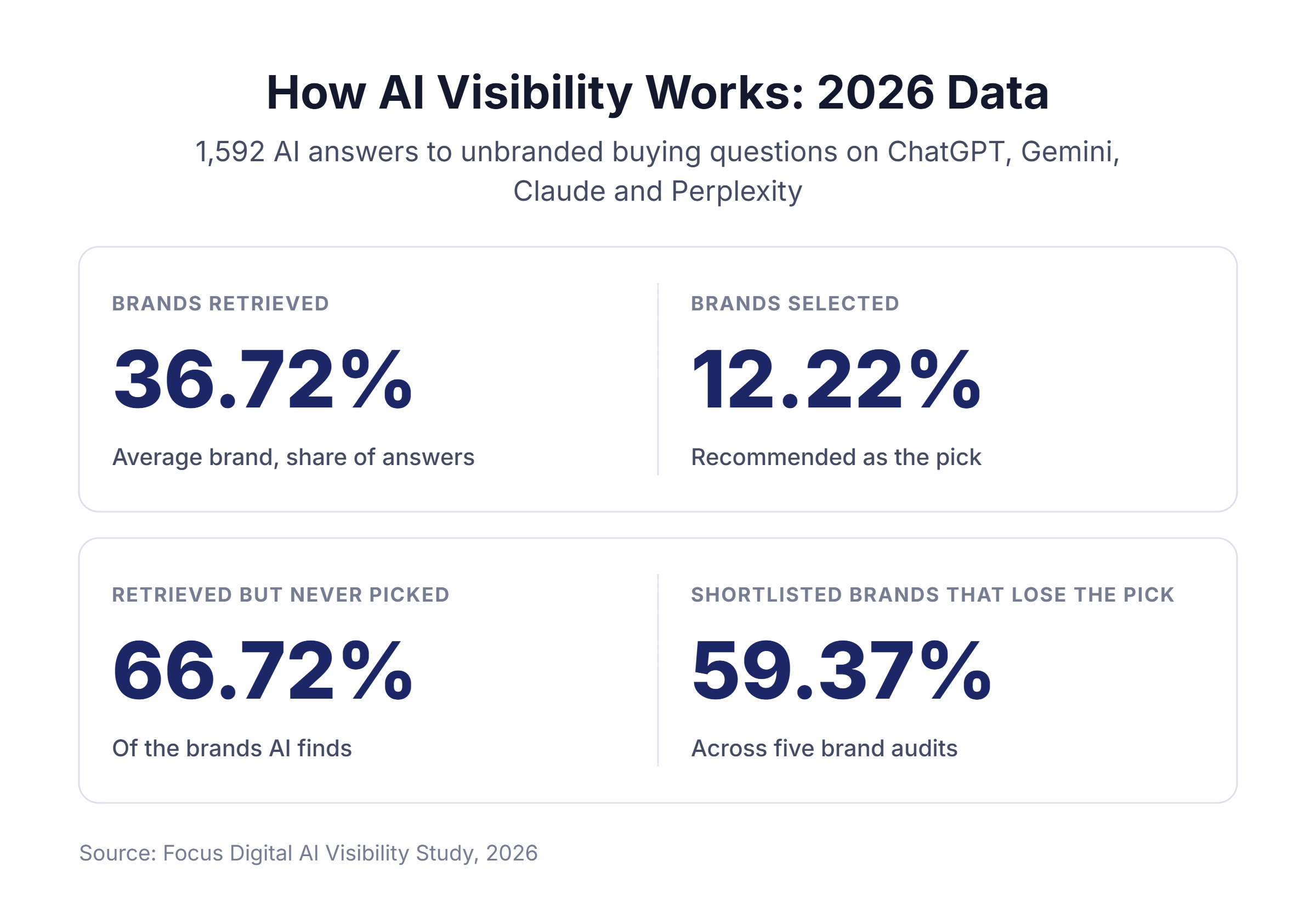
We measured both steps across 1,592 AI answers to unbranded buying questions on ChatGPT, Gemini, Claude, and Perplexity. The average brand was retrieved in 36.72% of answers and selected as the recommendation in 12.22%. That means 66.72% of the brands an AI finds never become the ones it picks.
AI Visibility Used to Be a One-Step Process
For most of 2024 and 2025, GEO (generative engine optimization) was mostly a ranking game. You got a comparison blog to rank first on Google, ChatGPT picked up that page, and it repeated the list. If you ranked, you were recommended.
Buyers changed that. People now write prompts the way they’d explain a problem to a friend: “I’ve had the same furnace for 14 years and it keeps short-cycling. Is it worth repairing, and who should I call in Naperville?” No single search answers that, so the AI breaks the prompt apart and does the research itself. The process now has two steps, and a brand has to win both.
Here’s how one answer gets built from start to finish.
Step One: Retrieval, or Does AI Know You Exist?
Retrieval starts with what’s called a query fan-out. The AI takes one prompt and subdivides it into several searches, runs them at the same time, and synthesizes the results back together. On a simple prompt ChatGPT runs about two searches. In agent and deep research modes, we regularly see one prompt split into 10 to 15.
| AI Platform | Fan-Out Queries per Prompt, 2026 | 2025 | Search Index Used |
|---|---|---|---|
| Google AI Mode | 8.73 | 6.27 | |
| Grok | 6.8 | 4.93 | X plus web search |
| Claude | 3.17 | 2.13 | Brave Search |
| ChatGPT | 2.1 | 1.07 | Bing plus OpenAI’s own crawler |
| Perplexity | 1.4 | 1.17 | Perplexity’s own index |
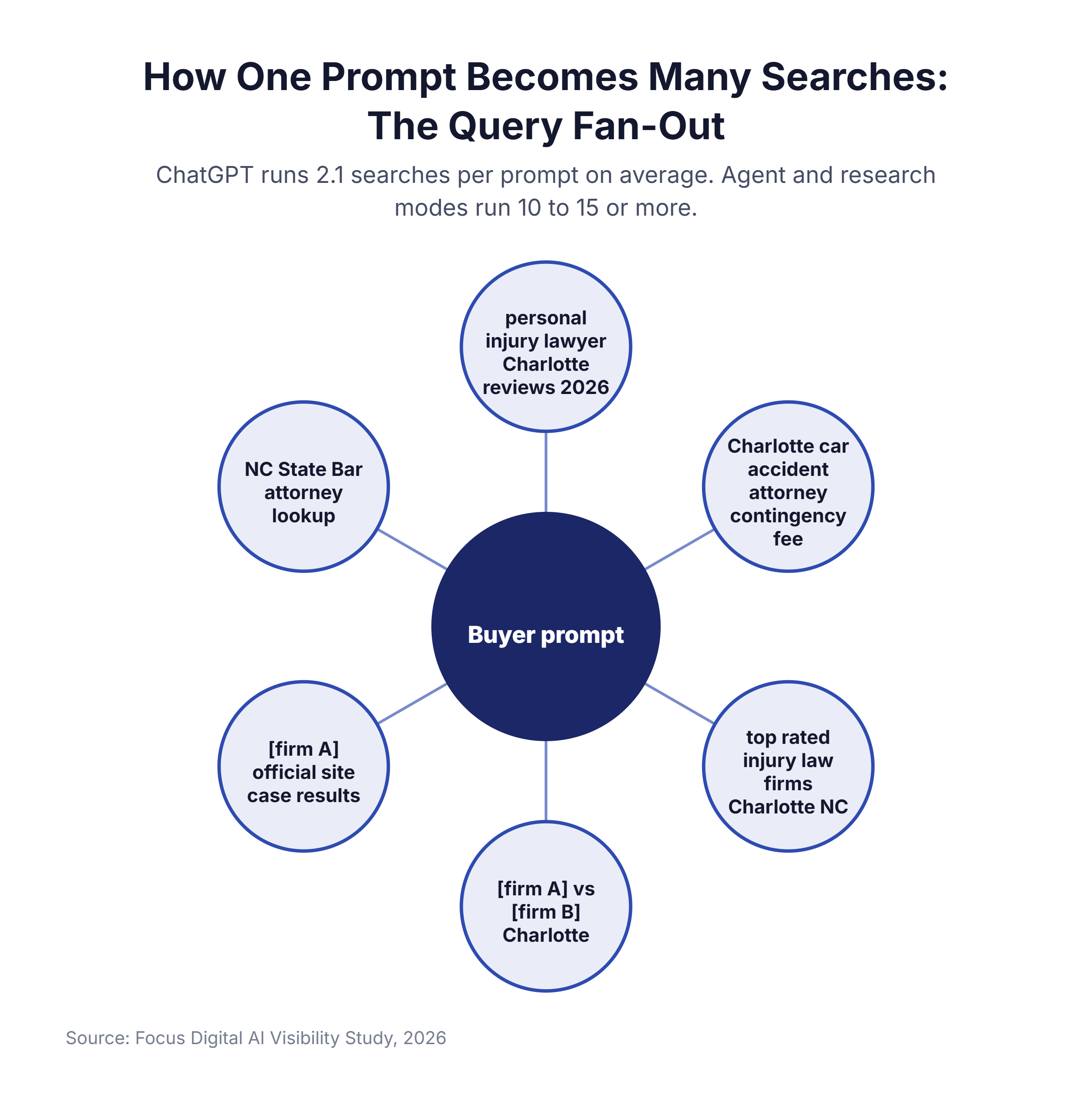
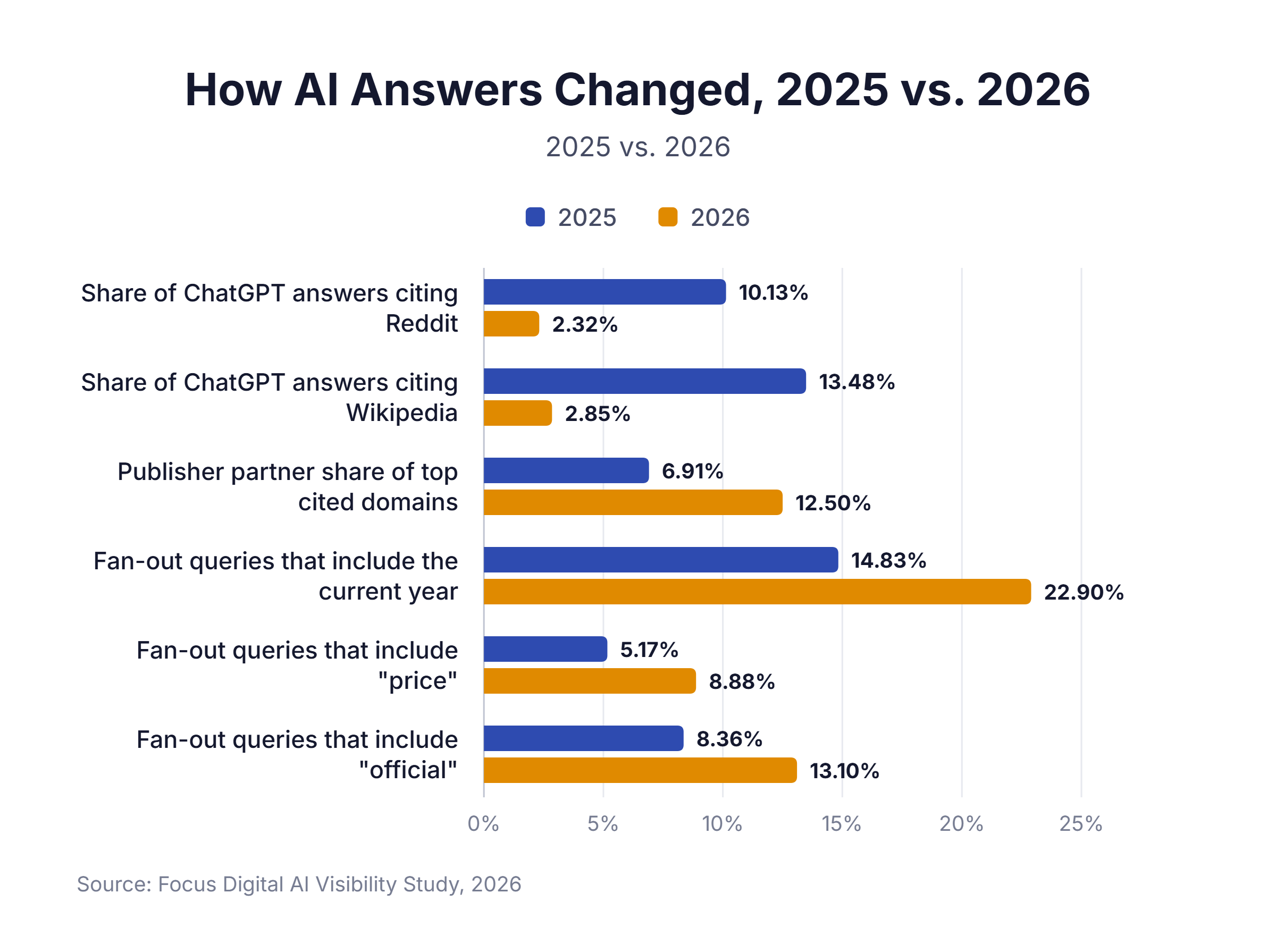
The fan-out queries read like a buyer’s checklist. 22.9% of ChatGPT’s fan-outs include the current year, 13.1% include the word “official,” and 8.88% include “price.” ChatGPT also goes straight to the source: 6.8% of its fan-outs use the site: operator, and 75.9% of the most common site: searches target brand websites. When the AI wants to confirm a price or a credential, it checks your site first. If the number isn’t there, it takes one from someone else.
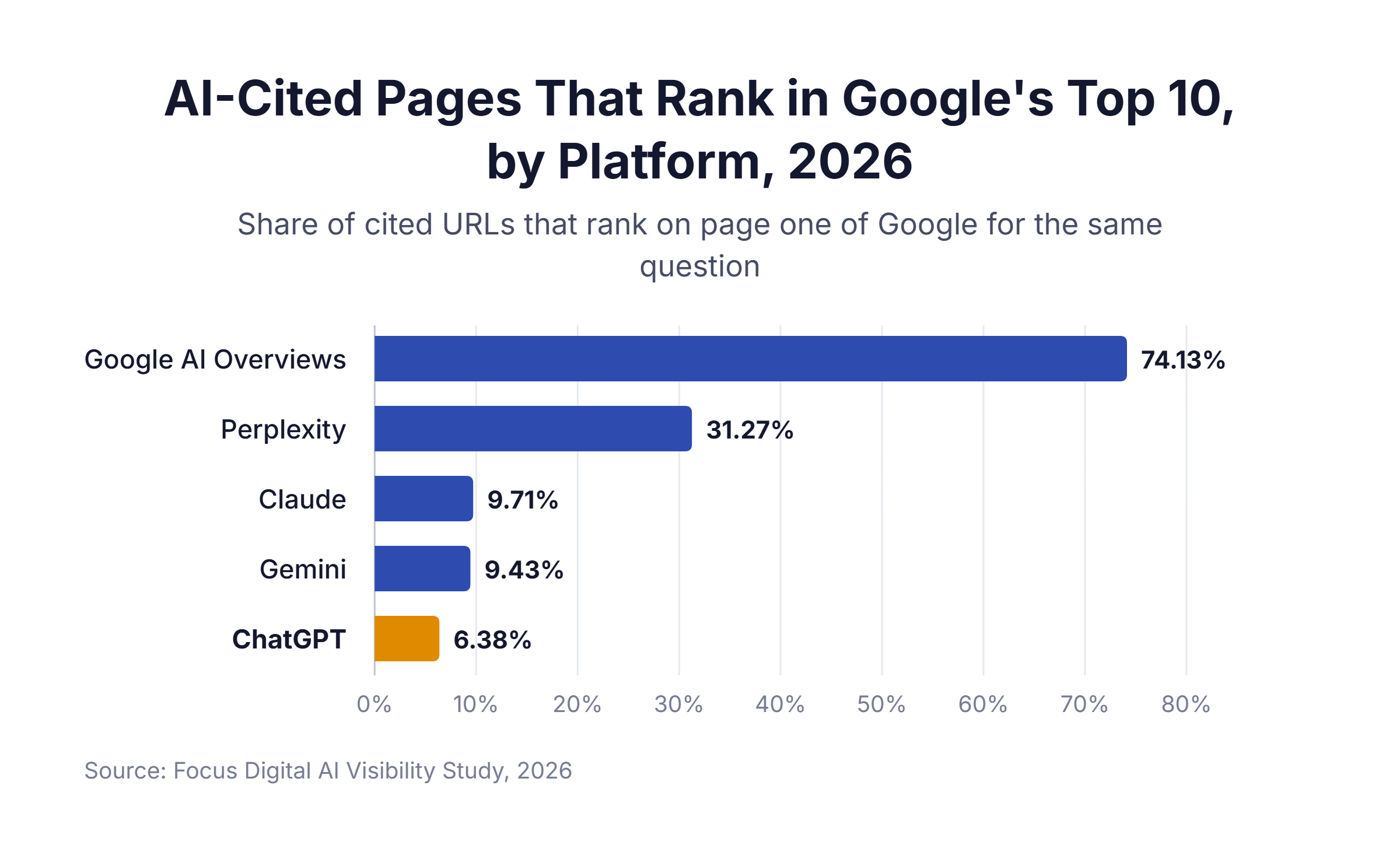
Every fan-out is a search, which makes retrieval a search ranking problem. How much Google rankings help depends on the platform. 74.13% of Google AI Overview citations rank in Google’s top 10 for the same question. For ChatGPT, that figure is 6.38%. ChatGPT searches Bing and its own crawl with reworded queries, so the page it cites often ranks for a sub-query the buyer never typed.
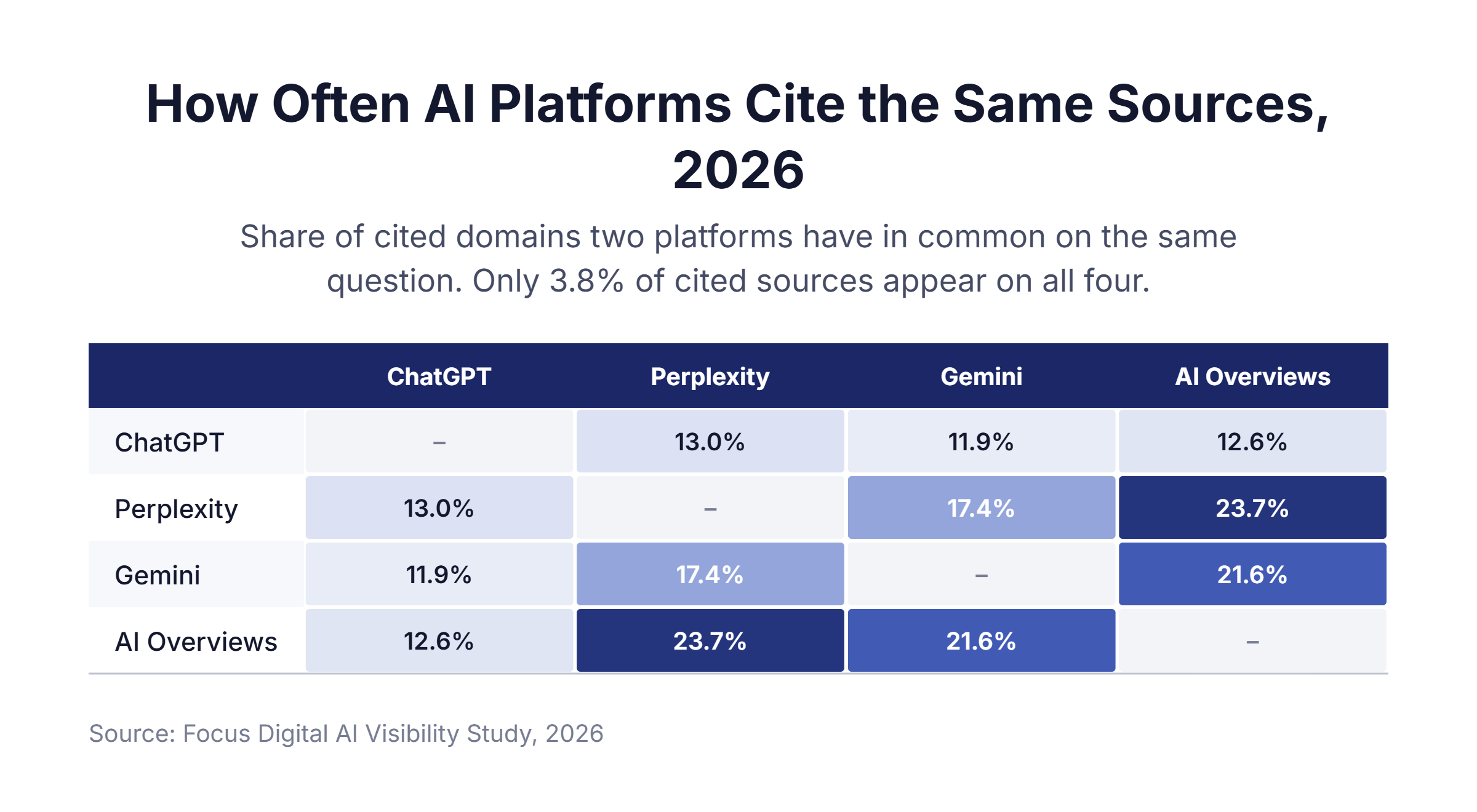
The platforms also disagree with each other more than most people expect. Only 3.8% of cited sources show up on all four major AI platforms for the same question, and 72% to 73% of cited domains appear on just one. Back when Google won search, every other search engine started copying Google, and the results converged. The LLMs haven’t reached that point. Each one weights things differently, so being visible on one engine doesn’t predict what will happen on the next.
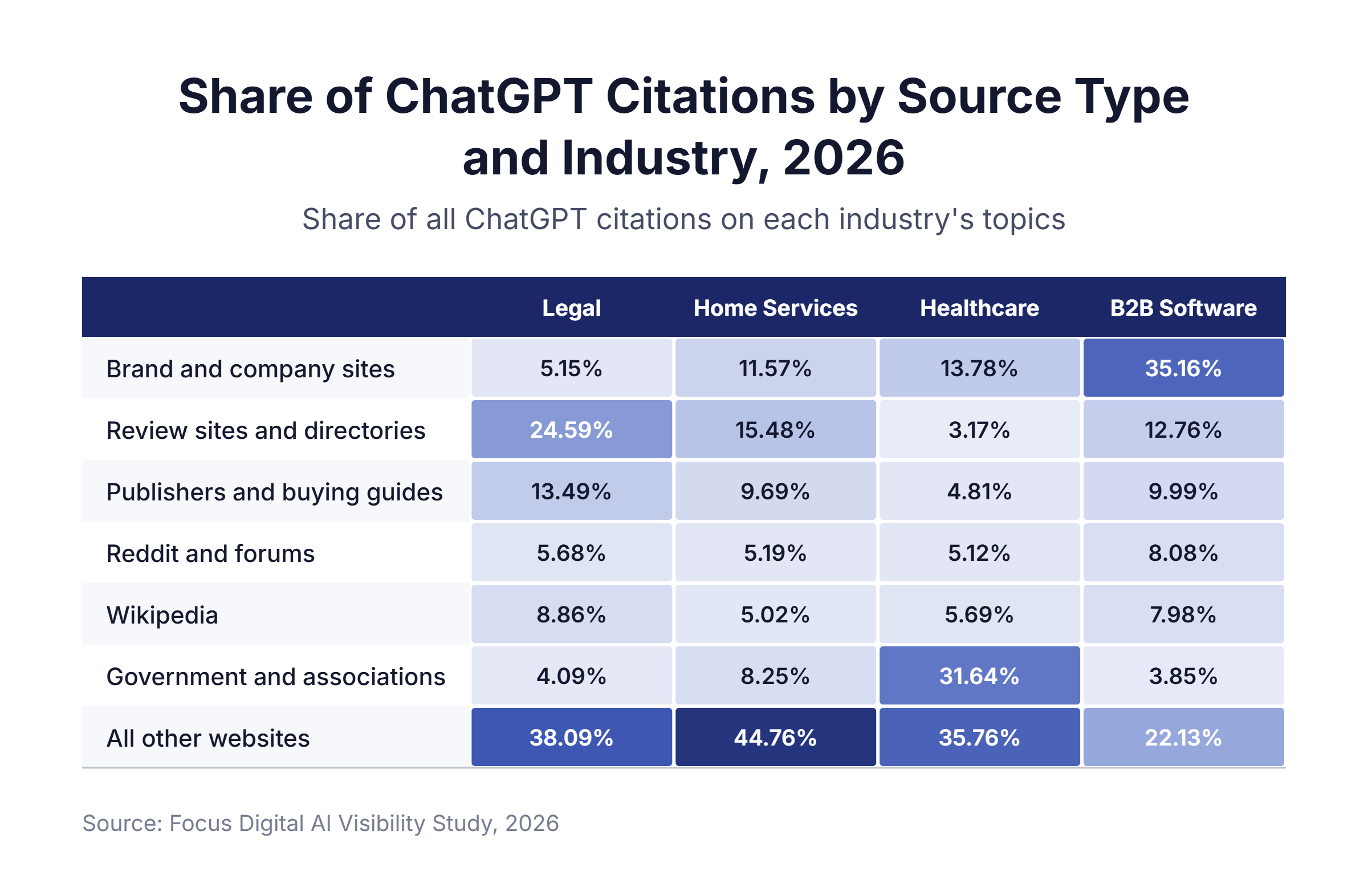
Where the AI looks also depends on your industry.
- In B2B software, brand and company sites earn 35.16% of ChatGPT’s citations, because software companies publish pricing, documentation, and comparison pages the AI can quote.
- In legal, review sites and directories earn 24.59%, so an attorney’s directory profiles supply most of the facts the AI repeats.
- In healthcare, government agencies and medical associations earn 31.64%.
Google AI Overviews also lean on video in a way ChatGPT doesn’t: on legal questions, YouTube earns 30.73% of AI Overview citations.
Step Two: Selection, or Does AI Actually Decide?
Selection is where most brands lose, and it’s the step most agencies aren’t measuring yet. Once the AI has a set of candidates, it evaluates each one against what the buyer described. It’s looking for very concrete, very specific information that verifies a company fits: who it serves, what it costs, how fast it works, and what credentials it holds. A brand that survives the culling onto the shortlist can still lose the pick if those facts aren’t on the page.
Here’s how that played out across five brand audits we ran this year.
| Brand Audit | AI Answers | Retrieved | Shortlisted | Selected |
|---|---|---|---|---|
| B2B business services | 32 | 56.25% | 53.12% | 28.12% |
| Auto dealership | 432 | 52.08% | 49.07% | 24.07% |
| B2B testing lab | 336 | 40.06% | 28.52% | 8.01% |
| Financial advisory firm | 288 | 24.35% | 20.23% | 4.36% |
| B2B software agency | 504 | 18.75% | 9.37% | 4.16% |
| All five brands | 1,592 | 36.72% | 30.08% | 12.22% |
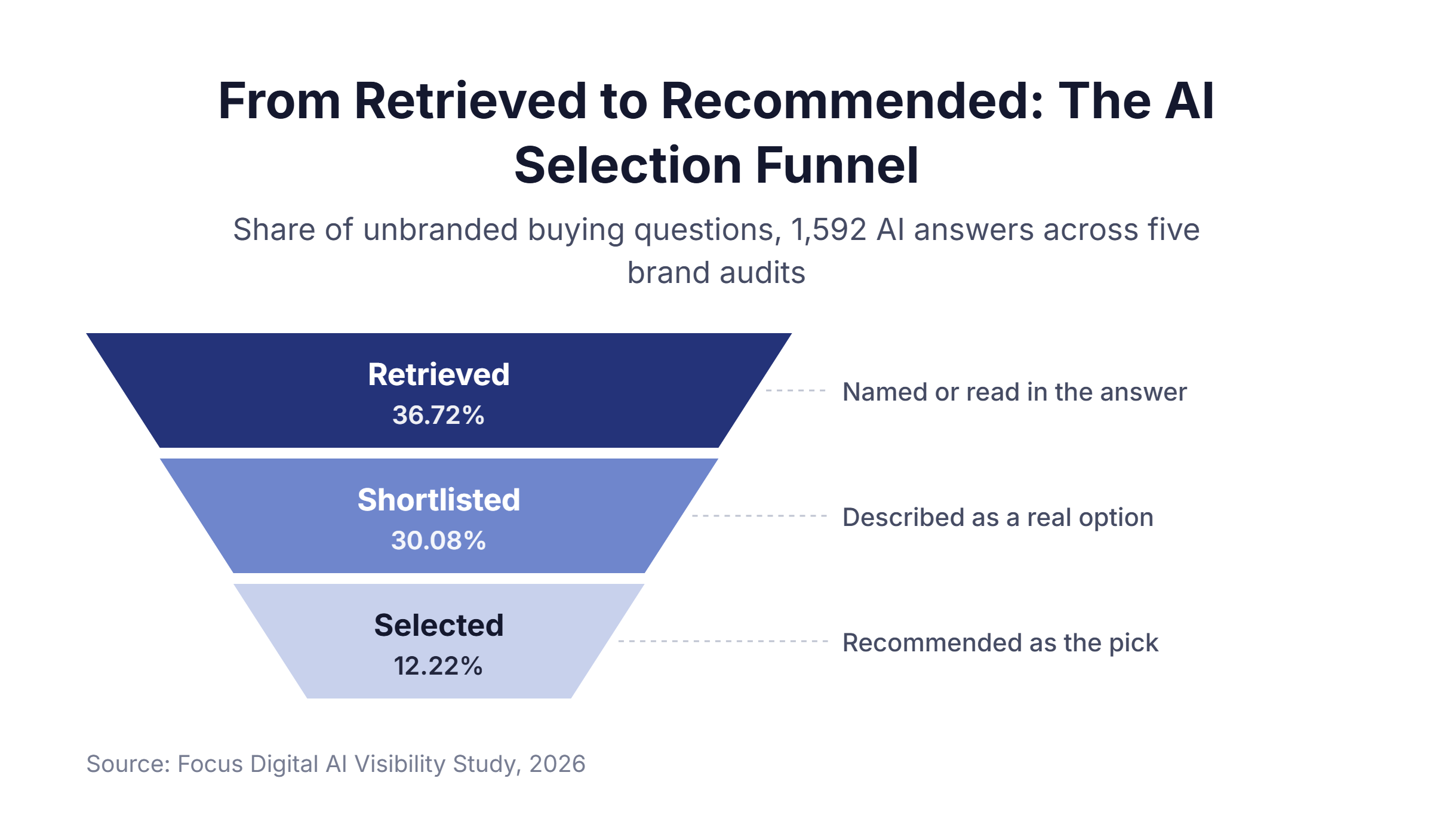
The biggest drop comes after the shortlist. 59.37% of shortlisted brands lose the final pick. In four of the five audits, the brand’s own website was the single most cited domain, and the brand was still recommended on only 4.16% to 28.12% of buying questions. The testing lab is the clearest example. The AI used the lab’s own comparison article to describe its competitors, and then it recommended those competitors. The lab’s site was the source, and someone else was the answer.
Three patterns showed up again and again:
- Segments with their own pages get named. The auto dealership was named on 78.7% of new car questions, where it had dedicated pages, and on 23.1% of used car and value questions, where it had none.
- The buyer’s wording changes the answer. The business services brand was the top pick on all four engines when the question said “partner program.” Three of the four dropped it when the same question said “white label.”
- Recognition and retrieval are separate tests. The software agency was named in 100% of answers when its name appeared in the question, and in 18.75% when the buyer only described a need.
So what’s a good number? Based on these audits, I’d call a selection rate of 18.33% or higher good, and anything under 8.55% a problem. I watch the brand’s own share of citations closely too. The average is 10.83%, and a good share is 16.24% or higher. It’s usually the first number to move once new pages get indexed, a few months before selection catches up.
What the AI Trusts When It Decides
AI compiles. It reads what trusted sources say about a business and repeats the consensus. I call that consensus a brand’s AI belief landscape: the set of statements every engine treats as true about the company. The question I ask now is what AI believes is true about a business, and four things shape that belief.
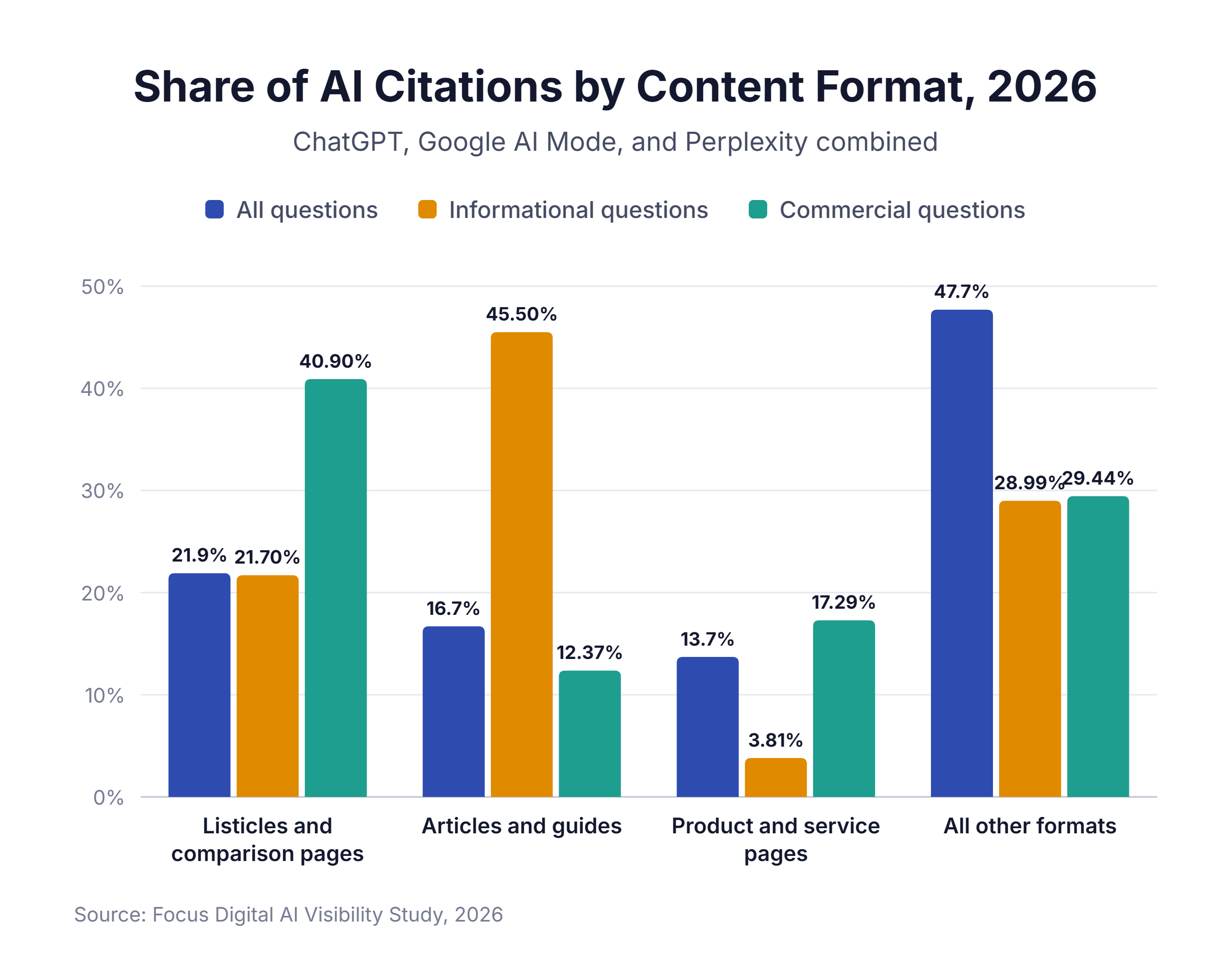
Format: Listicles and comparison pages earn 21.9% of all AI citations, more than any other format, and 40.9% on commercial questions. A comparison blog that ranks first on a brand’s own site can by itself be enough for ChatGPT to recommend that brand first. Tables help too. In one audit, every page the engines cited on annual compliance questions was a state-by-state table of deadlines and fees.
Freshness: ChatGPT cites pages 28.56% newer than the pages Google ranks for the same topics. Google AI Overviews are the exception: they cite pages of about the same age as Google’s own results, which fits their 74.13% overlap with Google’s top 10.
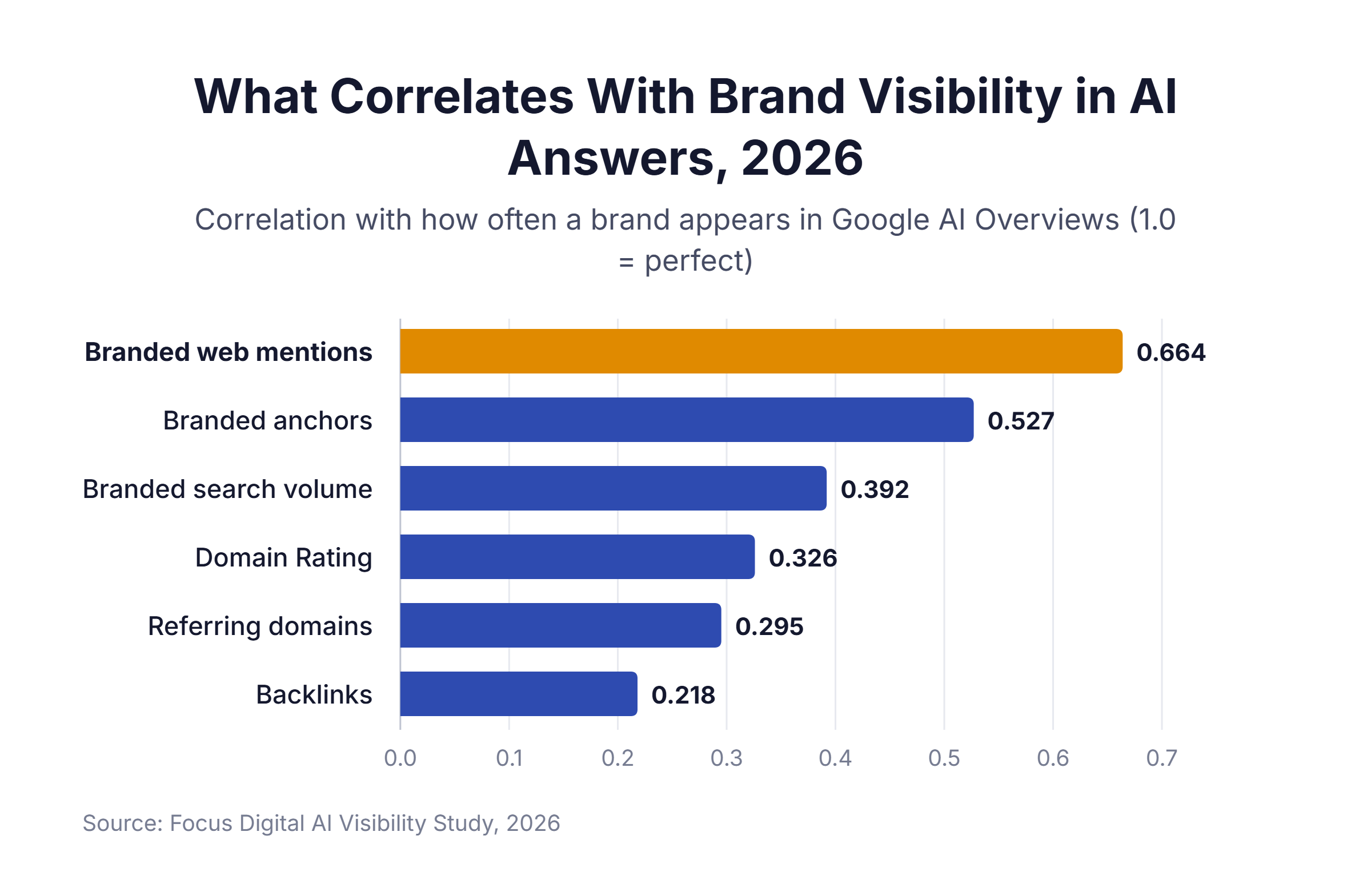
Mentions: Branded web mentions correlate with AI visibility at 0.664, three times as strongly as backlinks at 0.218. The AI reads the statement about the brand whether or not it carries a link, which is why the claims on your own pages need to match your directory profiles word for word.
Source mix: The mix shifted hard this year. The share of ChatGPT answers citing Reddit fell from 10.13% to 2.32%, and Wikipedia fell from 13.48% to 2.85%. Publisher partners rose from 6.91% to 12.5% of ChatGPT’s most cited domains. My theory is that the fan-outs got longer and more specific, and a lot of those specific queries just aren’t questions a Reddit thread answers. The AI goes to official and publisher pages, and a brand’s own site is one of those official pages.
What I Tell Clients to Do About It
I approach this from first principles. If I were the engineer designing one of these agents, I’d want it to do right by the person searching. So the goal is simple: give the agent all of the information it needs to properly evaluate you on behalf of its user. The pages that do that win over time, the same way genuinely useful content wins on Google.
The Suitability Page Fix
The highest-impact fix we’ve found is a suitability page: one page for each buying situation, stating who it’s for, the scope, the price, and the proof. In the dealership audit, segments with dedicated pages were named 240.69% more often than segments without them. For a service-area business, that means real numbers by market, such as jobs completed, technicians assigned, average response time, and first-visit fix rate. Buyers ask for exactly those things now. “I want a company that fixes my system and doesn’t try to sell me a new one” is a real prompt, and a published first-visit fix rate answers it.
Use the Buyer’s Actual Words
Next, use the buyer’s vocabulary. The business services brand went from one engine to four when the page used the words the buyer typed. Every service page should also carry at least four countable proof points, because those are the lines the AI quotes back. Closing that last step from shortlisted to selected was worth up to 103.86% in the dealership audit.
Google Rankings Still Make a Difference
Retrieval still depends on rankings, so the SEO work doesn’t go away. Pages in Google’s top 10 earn 216.66% more AI Overview citations than all lower-ranked pages combined. Comparison blogs earn 31.13% more citations than standard articles. Put the current year, price ranges, and an updated date on key pages, since 22.9% of fan-outs ask for the current year. Finally, use one name, address, and phone number everywhere. In one audit, the engines confused the brand with an unrelated company in 3.27% of answers.
Where AI Search Is Heading
I think the selection step only gets stricter from here. Prompts keep getting longer, agents keep reading more of each site, and search demand for AI visibility rose 233.33% this year, from 390 to 1,300 searches a month. The engines will converge eventually, the way search engines did around Google. Until then, they’ll keep weighting things differently, and the brands that win across all of them will be the ones that publish clear, specific facts about who they serve and what they deliver.
That’s the work we do every day at Focus Digital, and it’s the same work that earns Google rankings. The brands that start now will have a year of proof on the page before their competitors notice the second step exists.
How These Figures Are Calculated
- Retrieved, shortlisted, and selected rates = answers that name or read the brand, describe it as a real option, or recommend it as the pick ÷ unbranded buying-question answers × 100, weighted by the number of answers in each audit for the five-brand total
- Owned share of citations = citations to the brand’s own domains ÷ all citations in the audit × 100
- Source type share = ChatGPT citations to domains of that type ÷ all ChatGPT citations on the industry’s topics × 100
- Good and below average ranges = 1.5 times and 0.7 times the five-brand average
- Lift from a fix = (rate with the fix ÷ rate with the cause − 1) × 100, using paired figures from the audits and benchmarks in this study
- 2025 values = the same measures for the prior year, aligned to the same months
Requesting a Copy of This Report
If you’d like to request a PDF copy of this report or learn more about our agency, you can reach out here.
Sources
(9)
- Focus Digital AI Visibility Study, 2026. Selection funnel data covers 1,592 AI answers from five brand visibility audits run on ChatGPT, Gemini, Claude, and Perplexity in August and September 2026, with most prompts run three times on every engine. Citation source data covers 51,050 ChatGPT citations and 6,227 Google AI Overview citations on legal, home services, healthcare, and B2B software topics. Platform, format, freshness, and trend figures are compiled from the published benchmarks below and aligned to the same periods with Focus Digital modeling.
- Ahrefs, How ChatGPT Does Query Fan-Out (15 Million Queries Studied), October 2026
- Peec AI, Fan-Outs per Prompt by Engine, May 2026
- Ahrefs, Only 12% of AI Cited URLs Rank in Google’s Top 10 for the Original Prompt
- Writesonic, Do AI Engines Cite the Same Sources? 161,286 Prompts Across 4 Platforms, July 2026
- Ahrefs, AI Assistants Prefer to Cite Fresher Content (17 Million Citations Analyzed)
- Search Engine Land, AI Citations Favor Listicles, Articles, and Product Pages (Wix Studio AI Search Lab)
- Ahrefs, An Analysis of AI Overview Brand Visibility Factors (75K Brands Studied)
- Semrush, Reddit’s Citations in ChatGPT Fall