Average pages per session is arguably the metric most closely correlated with user satisfaction with the content curated on a website page. While average session duration is important, this metric does not sufficiently account for the true purpose of top-of-funnel content: moving visitors through the funnel toward more conversion-oriented content.
The average pages per session across all industries in this study is 3.81. Pages per session is calculated as Total Pages Viewed ÷ Total Sessions and is reported automatically in analytics platforms; note that Google Analytics 4 labels this metric “views per session.”
Key Takeaways:
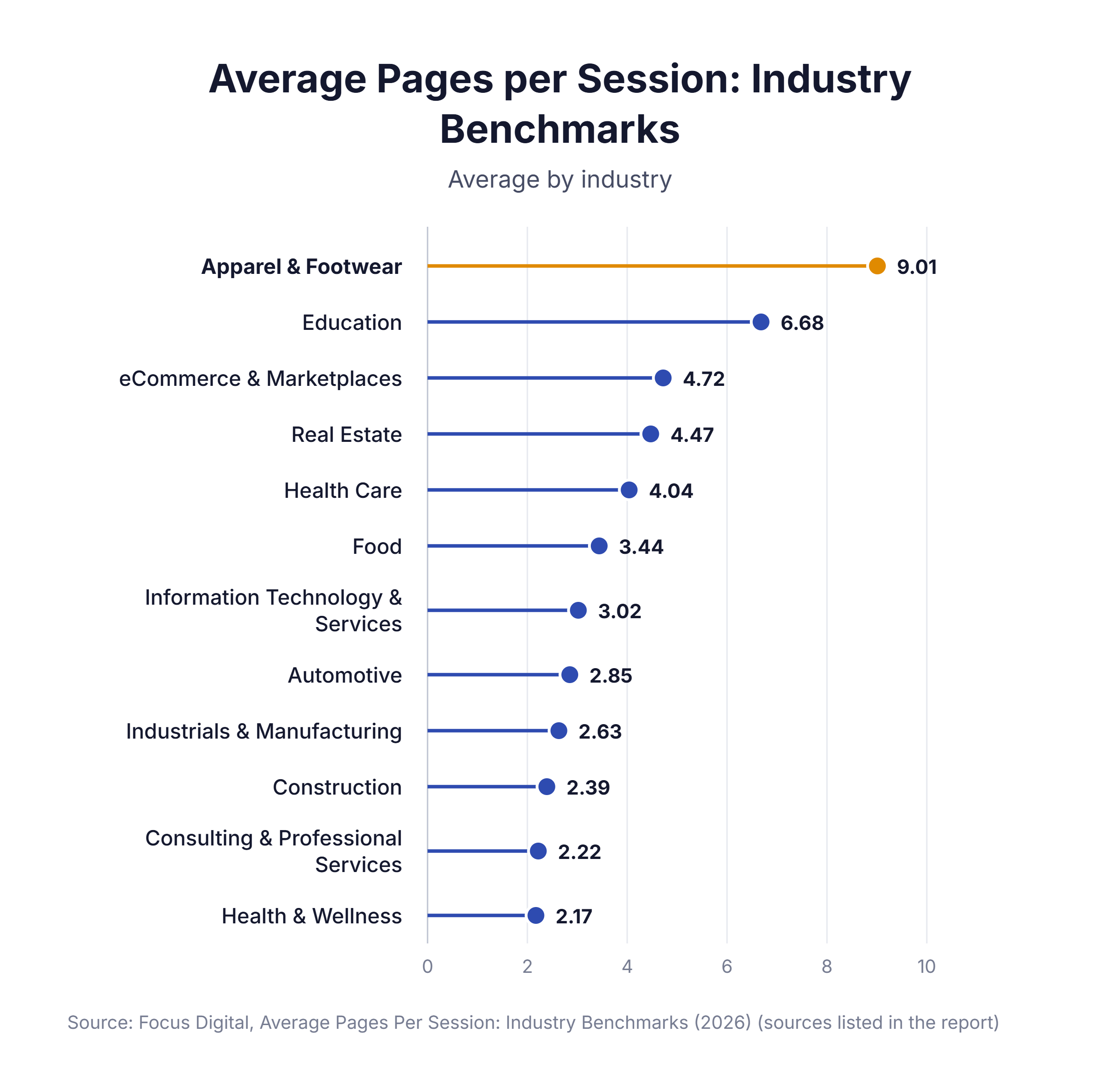
- Apparel & Footwear leads all industries at 9.01 pages per session; Health & Wellness (2.17) and Consulting & Professional Services (2.22) show the lowest browsing depth.
- Organic search drives the highest channel engagement at 5.8 pages per session, nearly double paid search (2.9).
- Lower-priced products ($5–$30) generate more than 3x the page views per session of enterprise-level purchases ($500K+), reflecting more extensive comparison shopping behavior.
Average Pages per Session: Industry Benchmarks
| Industry | Average | Recommended Target |
|---|---|---|
| Apparel & Footwear | 9.01 | 8.11 |
| Automotive | 2.85 | 3.71 |
| Construction | 2.39 | 3.11 |
| Consulting & Professional Services | 2.22 | 2.89 |
| eCommerce & Marketplaces | 4.72 | 5.66 |
| Education | 6.68 | 7.35 |
| Food | 3.44 | 4.13 |
| Health Care | 4.04 | 4.85 |
| Health & Wellness | 2.17 | 2.82 |
| Information Technology & Services | 3.02 | 3.62 |
| Industrials & Manufacturing | 2.63 | 3.42 |
| Real Estate | 4.47 | 5.36 |
| SaaS | 2.61 | 3.39 |
| Technology | 3.08 | 3.70 |
| Travel & Leisure | 3.76 | 4.51 |
Key Insights:
- Industries with higher product variety (like Apparel & Footwear) consistently show elevated page views as prospects explore multiple options before converting.
- B2B service industries (Consulting, SaaS, Technology) cluster around 2.2-3.1 average pages, indicating more targeted browsing behavior.
- Educational and healthcare sectors show higher engagement rates, likely because decision-making in these fields is research-intensive.
Average Pages Per Session by Product Price Point
In the table below, we examine how product pricing influences user browsing behavior and provide optimized targets for each price range.
Average Pages Per Session by Price Point: 2026
| Price Point Range | Average | Recommended Target |
|---|---|---|
| $5 – $30 | 7.5 | 8 |
| $20 – $150 | 6.8 | 7.5 |
| $50 – $300 | 5.6 | 6 |
| $100 – $1,000 | 4.8 | 5.3 |
| $1,000 – $10,000 | 3.5 | 4 |
| $5,000 – $50,000 | 3 | 3.5 |
| $10,000 – $50,000 | 2.8 | 3.3 |
| $15,000 – $40,000 | 2.7 | 3 |
| $40,000 – $100,000 | 2.5 | 2.8 |
| $50,000 – $500,000 | 2.4 | 2.7 |
| $100,000 – $1M+ | 2.3 | 2.5 |
| $500,000 – $5M+ | 2.2 | 2.4 |
Key Insights:
- Lower-priced products generate significantly more page views as customers engage in extensive comparison shopping.
- Enterprise-level purchases ($100K+) show the most focused browsing patterns, with prospects typically viewing only highly relevant content.
- The “sweet spot” for conversion optimization appears to be slightly above industry averages across all price points.
Average Pages Per Session by Traffic Channel
In the table below, we analyze how different traffic sources impact user engagement and browsing depth.
Average Pages Per Session by Traffic Channel: 2026
| Traffic Source | Average Pages per Session |
|---|---|
| SEO (Organic Search) | 5.8 |
| Direct Traffic | 4.3 |
| Referral | 4 |
| Email Marketing | 3.6 |
| Social Media | 3.2 |
| Paid Search | 2.9 |
Key Insights:
- Organic search traffic shows the highest engagement, indicating a strong intent match between content and user needs. However, AI Overviews are significantly reducing organic click-through rates in 2026; sites receiving organic traffic today increasingly satisfy deep or navigational intent, which may partially explain the continued high pages-per-session figure for this channel.
- Paid traffic shows the lowest pages per session, suggesting the need for more targeted landing page experiences.
- Email marketing performs moderately well, likely due to existing relationship and trust with the brand.
- AI Search (ChatGPT, Perplexity, Gemini) is Emerging as a Channel to Track: AI referral traffic grew over 500% year-over-year in 2025-2026. Early engagement data shows AI search visitors spend significantly more time on-site than traditional organic visitors, making this a channel worth segmenting in GA4 as referral volume grows.
Improving Your Average Pages Per Session
The best way to improve average pages per session is to write content that better satisfies visitors by taking the time to understand the strategic purpose of each page.
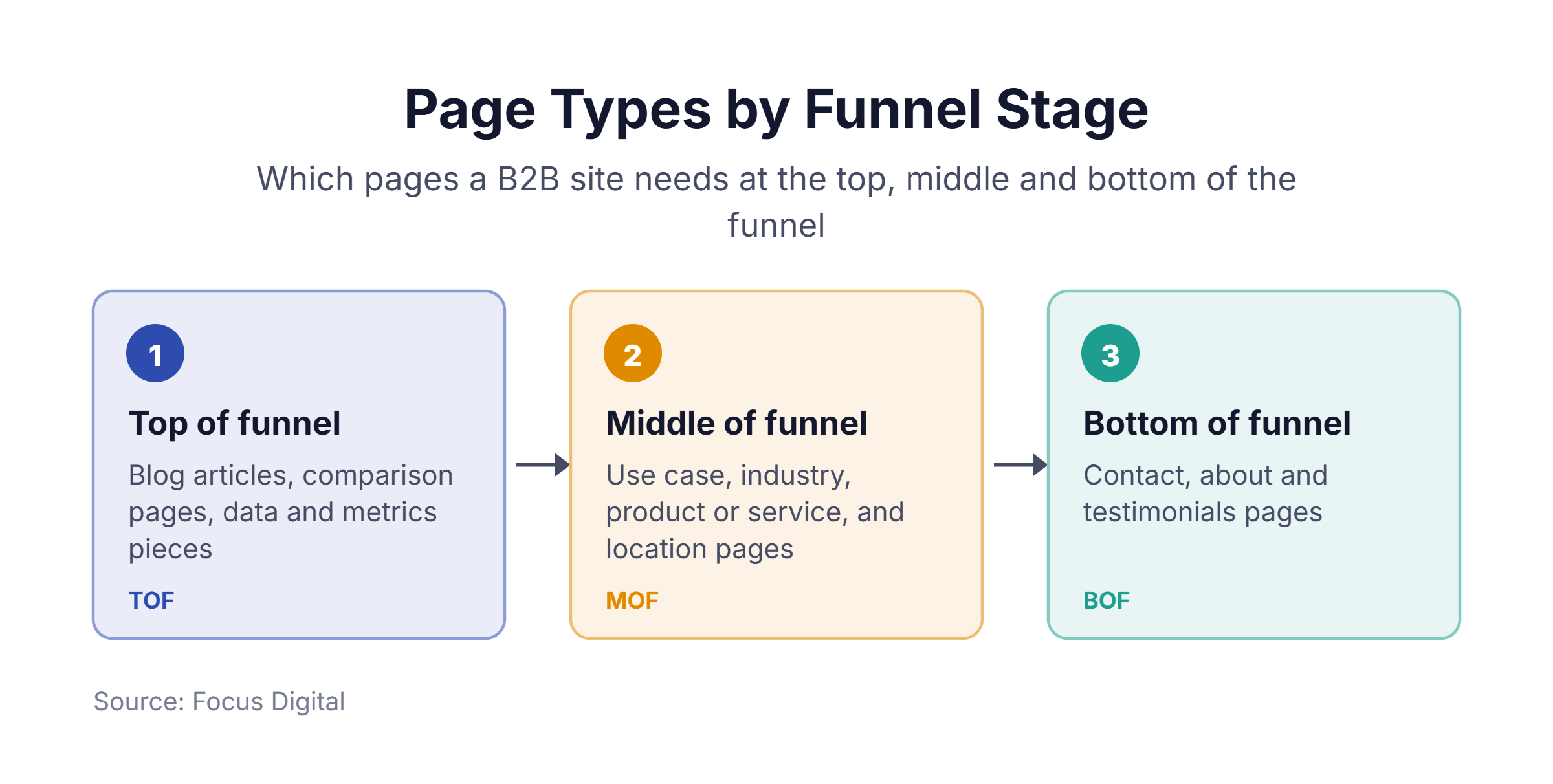
Pages such as blogs are meant to present visitors with content positioning your brand as a thought leader, not to sell the product. Product or service pages should display benefits and sell your product as an option, not convey your brand story. The about page should connect visitors with the personal side of your business, not advertise the products.
By understanding the purpose of each page, we can improve the average pages per session, as visitors naturally progress from the top of the funnel to the middle of the funnel to the bottom of the funnel as they are sold on your thought leadership, your products, and finally, your company. They must be taken in this order, as it mirrors human psychology.
Content Structure: Traffic Should Naturally Flow from Left to Right
When pages per session are tracked properly, we look for traffic generated in the top-of-funnel segment of the content structure, with the middle of the funnel serving as a transitional stage between traffic generation and traffic conversion.
Next Steps & Further Reading
If you are interested in reading further on this topic, we recommend the following articles:
- Customer Acquisition Cost Benchmarks by Industry
- Customer Acquisition Cost Trends
- Full Video SEO Training
If you are interested in learning more about implementing a content strategy that satisfies user intent and moves them further down the funnel toward becoming a lead, we are happy to consult. Feel free to contact us here.