The Focus Digital team analyzed average review response rates across seven service industries, four request methods, and multiple timing windows to compile this report. The overall average review response rate is 10 – 15% for service businesses using automated email requests, but this varies based on several key factors:
- Industry: Hospitality businesses where reviews are culturally expected outperform home services and retail by nearly 2–3x
- Request Method: In-person asks convert at rates automated email cannot match; a Harvard Business Review study found face-to-face requests are 34 times more effective than email for any personal ask
- Timing: Requests sent within 24 hours of service completion see 3x higher response rates than requests sent a week later
- Business Size: Single-location, owner-operated businesses consistently outperform multi-location enterprises due to personal touch and consistency
This article breaks down average review response rates for service businesses by industry, request method, and timing to help you identify where your business stands and where you can improve.
What We’re Measuring
Review response rate is the percentage of customers who leave a review after being asked.
We calculate it as:
Review Response Rate =
(Number of Reviews Received ÷ Number of Review Requests Sent) × 100
For example, if you send 100 review requests and receive 20 reviews, your response rate is 20%. This metric tells you how effective your review collection process is, independent of total customer volume.
Average Review Response Rate by Industry
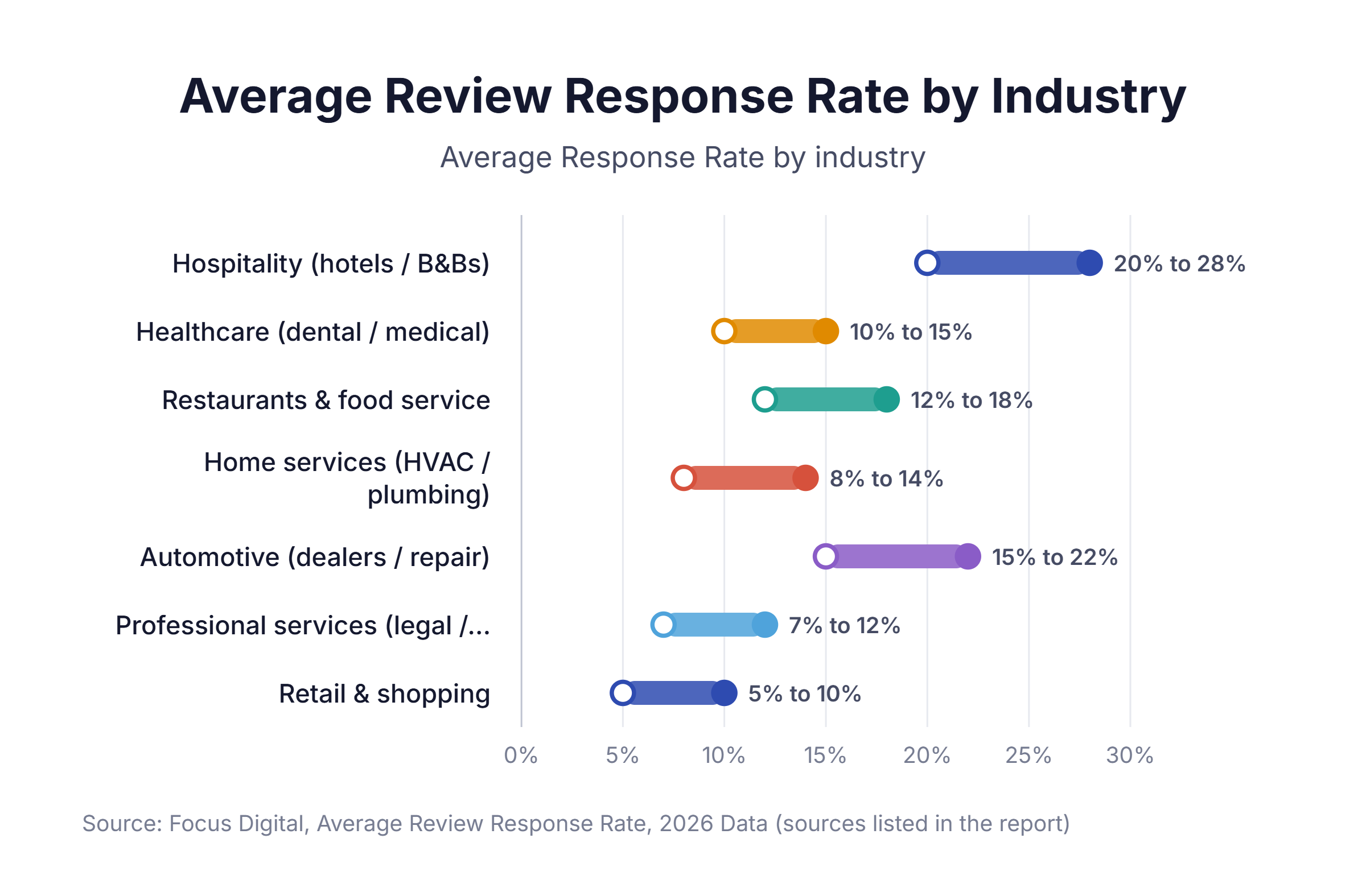
Different industries see different response rates. Hospitality businesses, where reviews are culturally expected, outperform home services businesses by nearly 2-3x.
| Industry | Average Response Rate | Negative Review Response Rate | Notes |
|---|---|---|---|
| Hospitality (hotels, B&Bs) | 20–28% | 16% | Highest response rates due to travel review culture |
| Healthcare (dental, medical) | 10–15% | 9% | HIPAA concerns limit some requests |
| Restaurants & food service | 12–18% | 11% | High volume but moderate response rates |
| Home services (HVAC, plumbing) | 8–14% | 10% | Lower response rates, but in-person asks help |
| Automotive (dealers, repair) | 15–22% | 13% | Dealerships see higher rates with follow-up |
| Professional services (legal, accounting) | 7–12% | 8% | Longer sales cycles delay review requests |
| Retail & shopping | 5–10% | 6% | High volume, lower engagement |
Hospitality leads because customers expect to leave reviews after hotel stays and restaurant visits. Home services and retail lag because review requests often arrive days after service when the experience isn’t top-of-mind. If your business falls below your industry average, your review request method is the first place to look.
Average Review Response Rate by Request Type
How you ask for a review matters more than most businesses realize. In-person requests convert at rates that automated emails can’t match.
| Request Method | Average Response Rate | Open Rate | Time to Response | Best Use Case |
|---|---|---|---|---|
| In-person ask (face-to-face) | 30–45% | N/A | Immediate to 24 hours | Point-of-sale or service completion |
| QR code (by the door/receipt) | 12–20% | N/A | Immediate to 1 hour | Retail, restaurants, service locations |
| SMS/text message | 18–28% | 90–98% | 2–4 hours | Follow-up within 24 hours of service |
| Automated email | 10–15% | 20–30% | 1–3 days | Post-service follow-up, B2B services |
| Hybrid (in-person + SMS follow-up) | 35–50% | N/A | Immediate to 24 hours | High-value services (dental, automotive, HVAC) |
| Automated email (no personalization) | 4–8% | 15–20% | 3–7 days | Mass requests, low engagement |
The data is clear: asking in person works. A Harvard Business Review study found that face-to-face requests are 34 times more effective than email. For service businesses, this means training your team to ask at the point of service, then following up with a text message containing the review link.
QR codes placed at checkout or by the door capture reviews while the experience is fresh. They work best in restaurants, retail stores, and service locations where customers have a few seconds to scan.
Text messages outperform email because they’re opened 90-98% of the time, compared to 20-30% for email. If you’re only using email, you’re losing 70% of your potential reviewers before they even see the request.
Average Review Response Rate by Timing
When you send the review request changes the response rate. Requests sent within 24 hours of service completion see 3x higher response rates than requests sent a week later.
| Request Timing | Response Rate | Response Quality | Best For |
|---|---|---|---|
| Immediate (at point of service) | 25–38% | High: experience is fresh | Retail, restaurants, quick services |
| Within 1–4 hours | 18–28% | High: still top-of-mind | Home services, automotive |
| 24–48 hours after service | 12–18% | Medium: some detail loss | Healthcare, professional services |
| 3–7 days after service | 7–12% | Medium to low: memory fades | B2B services, long projects |
| 1–2 weeks after service | 3–6% | Low: customers have moved on | Follow-up to non-responders only |
| 2+ weeks after service | 1–3% | Very low: often ignored | Not recommend |
Timing explains why hospitality businesses see higher response rates. Hotels send review requests within hours of checkout, when the experience is fresh. Home services businesses that wait 3-5 days to send requests miss the window when customers are most motivated to respond.
If you’re using automated review requests, set them to send within 24 hours of service completion. For businesses where service completion isn’t instant (multi-visit projects, ongoing services), send the request after the first positive milestone.
Average Review Response Rate by Business Size
Larger businesses with multiple locations often see lower response rates than single-location businesses. Consistency and personalization drop as scale increases.
| Business Size | Average Response Rate | Common Issues |
|---|---|---|
| Single location, owner-operated | 20-28% | High personal touch, in-person asks |
| 2-5 locations | 14-20% | Inconsistent processes across locations |
| 6-20 locations | 10-16% | Automation needed, less personal |
| 21-50 locations | 8-13% | Generic requests, minimal follow-up |
| 51+ locations (enterprise) | 6-10% | Volume focus over personalization |
Solo operators who ask in person see the highest response rates. Multi-location businesses that don’t standardize their review request process see wide variation between locations. Enterprise businesses (50+ locations) often achieve consistency through automation but sacrifice the personal touch that drives response rates above 20%.
The fix for multi-location businesses: standardize the in-person ask, then automate the text message follow-up. This preserves the personal connection while ensuring every customer receives a request.
Next Steps
Based on these benchmarks, here’s how to improve your review response rate:
If your response rate is below 10%:
- Add in-person asks at point of service
- Switch from email-only to SMS text requests
- Send requests within 24 hours of service completion
If your response rate is 10-18%:
- Implement QR codes at checkout or service completion
- Use hybrid approach (in-person ask + automated SMS follow-up)
- Personalize automated requests with customer name and service details
If your response rate is above 18%:
- Maintain consistency across all locations
- Monitor response rates by request method and timing
- Focus on responding to reviews (73% business response rate is the 2026 average)
Want a detailed analysis of your current review response rate?
Contact Focus Digital for a custom review collection audit. We’ll analyze your current process, benchmark your performance against your industry, and identify specific changes that will increase your response rate.