The duration of your webinar directly impacts how many attendees complete the session, how engaged they remain, and ultimately, how many convert to your desired action. This report analyzes hundreds of different webinars across 10+ industries to quantify the precise relationship between webinar length and conversion outcomes.
This research synthesizes data from Focus Digital’s analysis, with data sources that include webinar platform analytics from ON24, ClickMeeting, and Contrast, plus proprietary conversion tracking from Focus Digital’s B2B webinar campaigns.All duration measurements reflect actual presentation time, excluding pre-show countdowns and post-webinar networking periods.
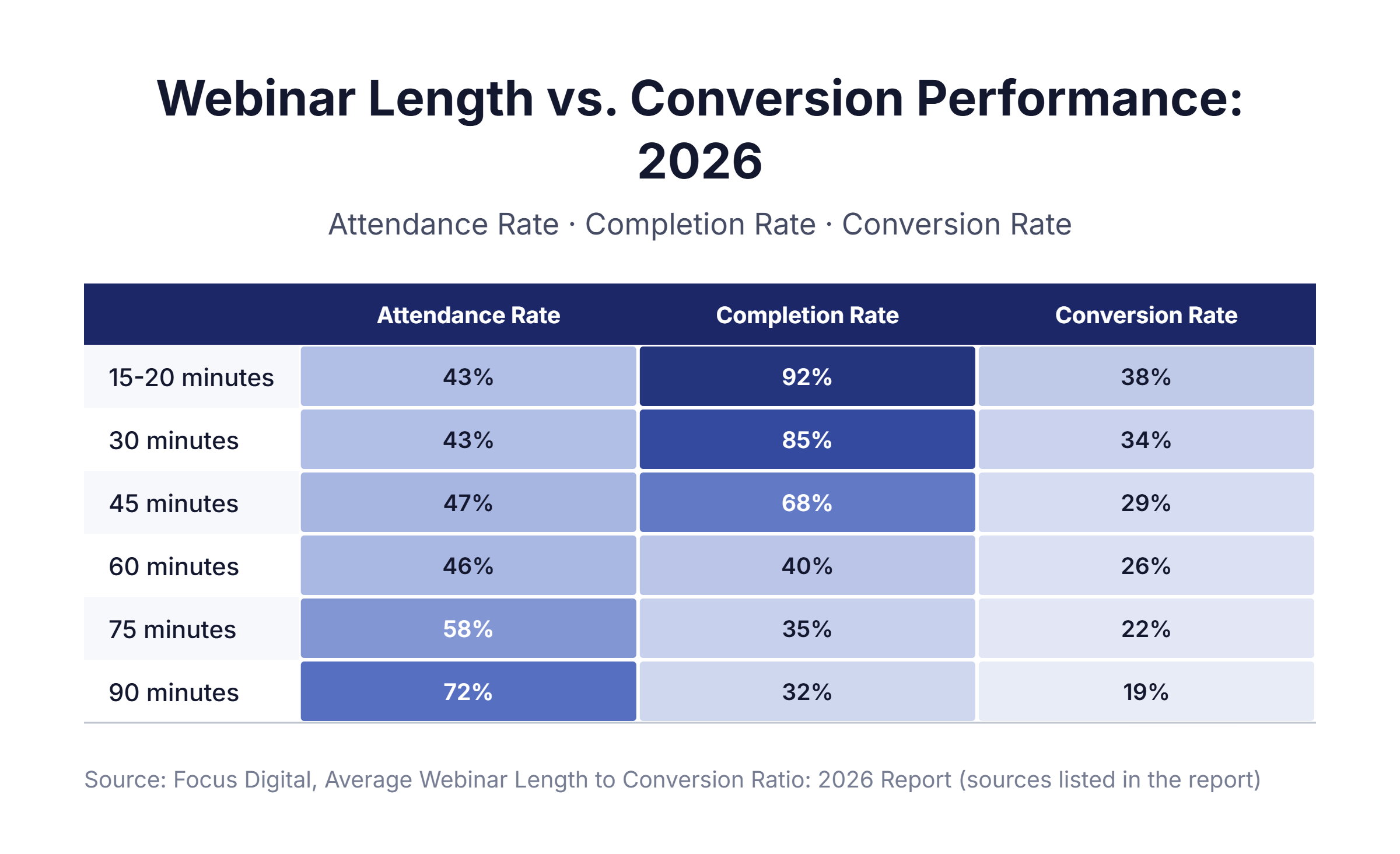
Webinar Length vs. Conversion Performance: 2026
| Webinar Duration | Attendance Rate | Completion Rate | Conversion Rate | Cost Per Conversion | Optimal Use Case |
|---|---|---|---|---|---|
| 15-20 minutes | 43% | 92% | 38% | $34 | Micro-demos, feature announcements |
| 30 minutes | 43% | 85% | 34% | $38 | Product demos, quick-win topics |
| 45 minutes | 47% | 68% | 29% | $42 | Educational content, thought leadership |
| 60 minutes | 46% | 40% | 26% | $51 | Comprehensive training, deep-dive topics |
| 75 minutes | 58% | 35% | 22% | $67 | Technical workshops, expert audiences |
| 90 minutes | 72% | 32% | 19% | $78 | Multi-session training, certification programs |
Key Insights:
- The 45-60 minute window optimizes conversion rate, completion rate, and content depth for most B2B audiences. Webinars in this range convert 26-29% of attendees. Shorter formats achieve higher completion but lack trust-building time for complex B2B conversions.
- Micro-webinars (15-20 minutes) convert 38% of attendees because of audience self-selection. Registrants have already decided they’re interested; the brief session confirms that interest. However, this format works best for warm audiences already familiar with your brand.
- Sixty-minute webinars face a completion crisis, only 40% of attendees reach your closing CTA. This creates a paradox: you have time to build comprehensive cases, but 60% of your audience never hears it. Integrate multiple CTAs at minutes 30, 45, and 55.
Engagement Decline Throughout Webinar Duration: 2026
| Time Marker | Engagement Level | Attendee Retention | Question Submission Rate | Critical Threshold |
|---|---|---|---|---|
| 0-5 minutes | 95% | 100% | 12 per 100 attendees | First impression window |
| 10 minutes | 89% | 97% | 18 per 100 attendees | Peak engagement begins |
| 20 minutes | 82% | 93% | 22 per 100 attendees | Maximum interaction point |
| 30 minutes | 73% | 85% | 19 per 100 attendees | First fatigue wave |
| 45 minutes | 65% | 68% | 14 per 100 attendees | Critical drop-off threshold |
| 60 minutes | 40% | 40% | 8 per 100 attendees | Conventional webinar endpoint |
| 75 minutes | 35% | 35% | 5 per 100 attendees | Diminishing returns begin |
| 90 minutes | 32% | 32% | 3 per 100 attendees | Extended session endpoint |
Key Insights:
- The 45-minute mark is an engagement cliff edge. Before 45 minutes, you lose 3-4% of attendees per 10-minute segment. After 45 minutes, drop-off accelerates to 8-12% per segment. You’re fighting human biology, and biology always wins.
- Peak engagement occurs at minute 20, not the beginning. While 95% are present at start, true cognitive engagement peaks at minute 20. Deliver your critical message or primary CTA between minutes 18-22 when 22 questions per 100 attendees signal maximum processing.
- Question submission rates predict conversion potential. At minute 20, you see 22 questions per 100 attendees, active evaluation. By minute 45, that drops to 14 (down 36%). By minute 75, only 5 questions per 100 signals passive consumption incompatible with conversion decisions.
Optimal Webinar Length by Industry: 2026
| Industry | Optimal Duration | Average Conversion Rate | Completion Rate | Why This Length Works |
|---|---|---|---|---|
| E-commerce/ Retail | 38 minutes | 35% | 74% | Fast purchasing cycles demand quick ROI demonstration |
| SaaS/ Technology | 52 minutes | 28% | 58% | Complex products require feature depth + use case exploration |
| Consulting/ Professional Services | 48 minutes | 31% | 63% | Authority building needs time; decision-makers are time-constrained |
| Healthcare/ Medical | 55 minutes | 26% | 51% | Compliance and credentialing require thorough explanation |
| Financial Services | 58 minutes | 25% | 47% | Regulatory complexity + risk aversion demand comprehensive coverage |
| Education/ Training | 65 minutes | 24% | 44% | Learning outcomes require extended instruction + practice |
| Manufacturing/ Industrial | 50 minutes | 27% | 56% | Technical specifications need depth; engineers tolerate longer formats |
Key Insights:
- E-commerce’s 38-minute sweet spot reflects transactional decision velocity. Online retail buyers need product differentiation, clarity and risk mitigation, not extensive trust-building. This duration showcases products, demonstrates use cases, and addresses objections without exhausting fast-twitch decision cycles characteristic of e-commerce audiences.
- Financial services require 58 minutes due to risk psychology, not content complexity. Financial decision-makers operate under heightened loss aversion; they fear wrong choices more than desire right ones. Extended duration provides repetition, social proof, and objection handling to overcome fear barriers that shorter formats leave unresolved.
- SaaS hits 52 minutes where product complexity meets executive time constraints. Webinars must demonstrate sufficient product depth while showcasing relevant use cases. This dual requirement demands more time than simple demos, yet SaaS buyers won’t tolerate 75-minute sessions. Fifty-two minutes satisfies the technical evaluation without triggering time-cost objections.
Ideal Webinar Duration by Type and Format: 2026
| Webinar Type | Ideal Duration | Conversion Rate | Completion Rate | Primary Objective | Content Structure |
|---|---|---|---|---|---|
| Product Demo | 35 minutes | 32% | 78% | Showcase features → prove value → close | 5-min intro, 20-min demo, 10-min Q&A |
| Sales Presentation | 42 minutes | 30% | 71% | Establish problem → present solution → create urgency | Problem (10), Solution (20), Offer (12) |
| Lead Generation | 45 minutes | 29% | 68% | Deliver value → build authority → capture contact | Education (30), Authority (10), CTA (5) |
| Thought Leadership | 50 minutes | 27% | 61% | Share insights → position as expert → soft CTA | Insights (35), Framework (10), Closing (5) |
| Training / Education | 65 minutes | 24% | 44% | Teach skill → demonstrate application → certify learning | Instruction (40), Practice (15), Recap (10) |
| Panel Discussion | 48 minutes | 28% | 64% | Multiple perspectives → audience Q&A → relationship building | Discussion (30), Q&A (15), Wrap (3) |
| Case Study Presentation | 40 minutes | 31% | 72% | Situation → challenge → solution → results | Context (8), Process (22), Results (10) |
Key Insights:
- Product demos achieve 32% conversion because intent aligns with content perfectly. Attendees are high-intent prospects evaluating specific solutions. Thirty-five minutes showcases core features, demonstrates real use cases, and addresses implementation concerns. Extending past 40 minutes introduces fatigue without adding conversion value.
- Training webinars accept 44% completion rates because learning requires time. Skill acquisition demands instruction, demonstration, practice, and feedback loops. Compressing training into 30 minutes sacrifices learning outcomes for completion metrics. The 65-minute duration prioritizes meaningful skill transfer among completers over high watch-through rates.
- Lead generation webinars at 45 minutes optimize the value-capture exchange. This format provides 30 minutes of genuine education (building reciprocity), 10 minutes of authority positioning (establishing credibility), and a clear 5-minute CTA. Too much education without asking yields satisfied non-converters; too little feels like bait-and-switch.
Requesting a Copy of This Report
If you’d like to request a PDF copy of this report or learn more about how Focus Digital helps companies optimize webinar strategy for maximum conversion impact, you can reach out to the Focus Digital team.