
Estimated Reading Time: 9 Minutes
A top-of-page ranking on the first page of Google for the right keywords is all that most accounting firms need to generate enough leads to sustain and grow the firm month after month and year after year. In this article, we’re detailing the top accounting firm SEO strategies to land your firm a spot on the first page.
In this article:
- Strategy One: Selecting high-intent keywords to rank for
- Strategy Two: Assigning the correct page type for each keyword
- Strategy Three: Writing high-converting, thought leadership content
Strategy One: Selecting High-Intent Keywords to Rank For
The first and arguably the most important SEO strategy for accounting firms is keyword selection. Many firms are competing for valuable page space on Google, so firms must cut through the noise with their keyword selection in order to stand out and rank in the crowded marketplace.
The first step to keyword selection is developing an understanding of how keywords translate to the intent of the searcher (or what they are hoping to find on your page). Every person falls into one of five levels of awareness. Each level of awareness translates to a different keyword type, and each keyword will translate to a different page type (more on page types later).
Defining the Levels of Buyer Awareness
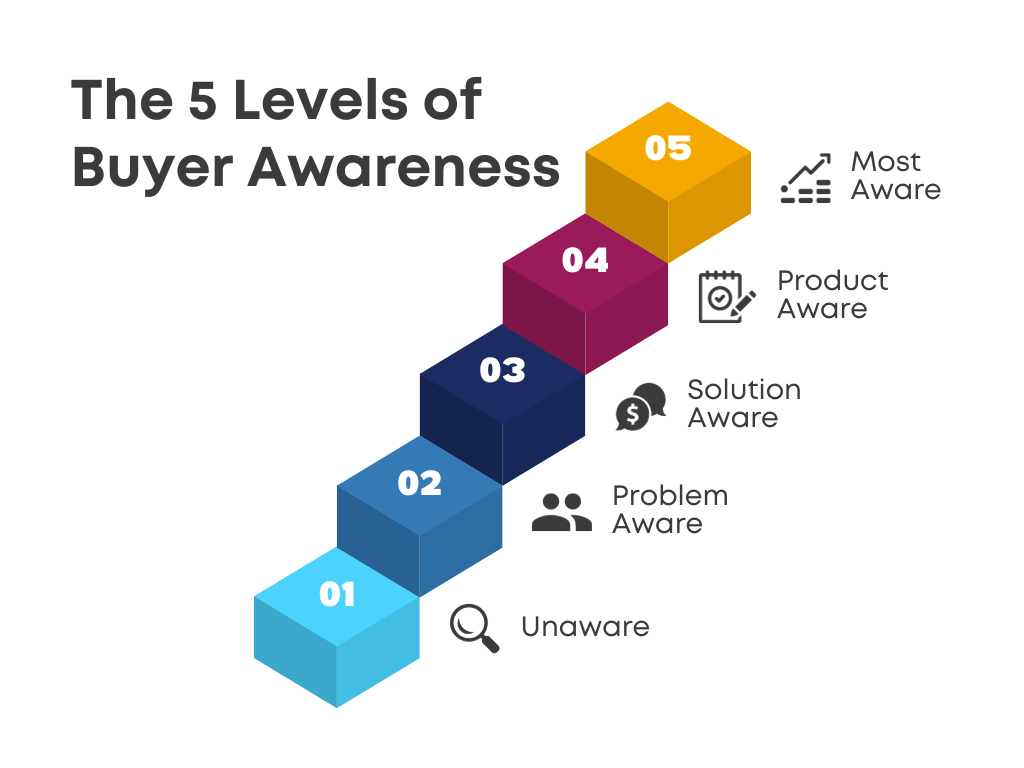
| Level of Awareness | Definition |
|---|---|
| Unaware |
At this level, the potential client is unaware of any problem that must be solved. Generally, marketers focus on problem education at this stage. |
| Problem Aware |
In this stage, the potential client is aware of a particular problem he or she might have but remains unaware that solutions are available for their problem. |
| Solution Aware |
Potential clients in this state are consciously aware that solutions exist for their problem, but they do not yet know about specific offerings your firm may provide. |
| Product Aware |
At the product aware level, the potential client is informed about your firm and the various value propositions you provide, but is not convinced that your firm provides the best solution firm for them. |
| Most Aware |
Finally, most aware potential clients believe your firm is most likely the right solution for them, but may require a slight nudge in order to give your firm their business. |
Below, the stages of awareness as they apply to a potential audit client are broken down.
| Level of Awareness | Definition |
|---|---|
| Unaware |
At this stage, the client doesn’t understand the need for auditing services. At a maximum, they are aware that potential risks and compliance issues relating to their financial practices may exist. |
| Problem Aware |
The problem aware stage begins when the potential client comes to an understanding of their need to be financially compliant, manage risks, or improve their financial processes. However, they do not know that an auditing service can assist them with this. |
| Solution Aware |
A solution-aware potential client understands that an auditing service is the solution to the aforementioned problems, but does not yet know of your firm or what your auditing services look like for them in their business. |
| Product Aware |
At this level, the potential client knows about your accounting firm and the auditing services you provide, but they are not convinced you are the best choice for them. They are still weighing your firm against competitors and need more information to make a decision. |
| Most Aware |
Finally, a most aware potential client is on the cusp of hiring your firm. These clients need to be pushed over the edge with a promise to go above and beyond for them. |
Keyword Selection
When we move to select our keywords, we begin with the most aware keywords and work backward. In the table below, we’ve outlined some potential keywords that would fit each level of awareness.
| Level of Awareness | Example Keywords |
|---|---|
| Unaware | “Improving business financial health”, “How to manage business finances” |
| Problem Aware |
“Common financial compliance issues”, “Risks of inaccurate financial reporting” |
| Solution Aware | “Benefits of professional auditing”, “Types of financial audits” |
| Product Aware | “Experienced financial auditing firm”, “Auditing firm near me” |
| Most Aware |
“Partner & Partner audit consultation”, “About Partner & Partner accounting firm” |
When selecting keywords, there are four rules you must follow.
- The keyword must autocomplete within the list of ten items in the Google search box (see below)
- The keyword must be plausibly searched by someone in the market for your product or service (for this reason, we typically don’t select unaware keywords)
- Your site must not already rank for that keyword with another page
- The keyword should not be so competitive that your site will not rank for it for 24+ months (For example, Deloitte or EY is targeting the same keyword and occupies the number one position)
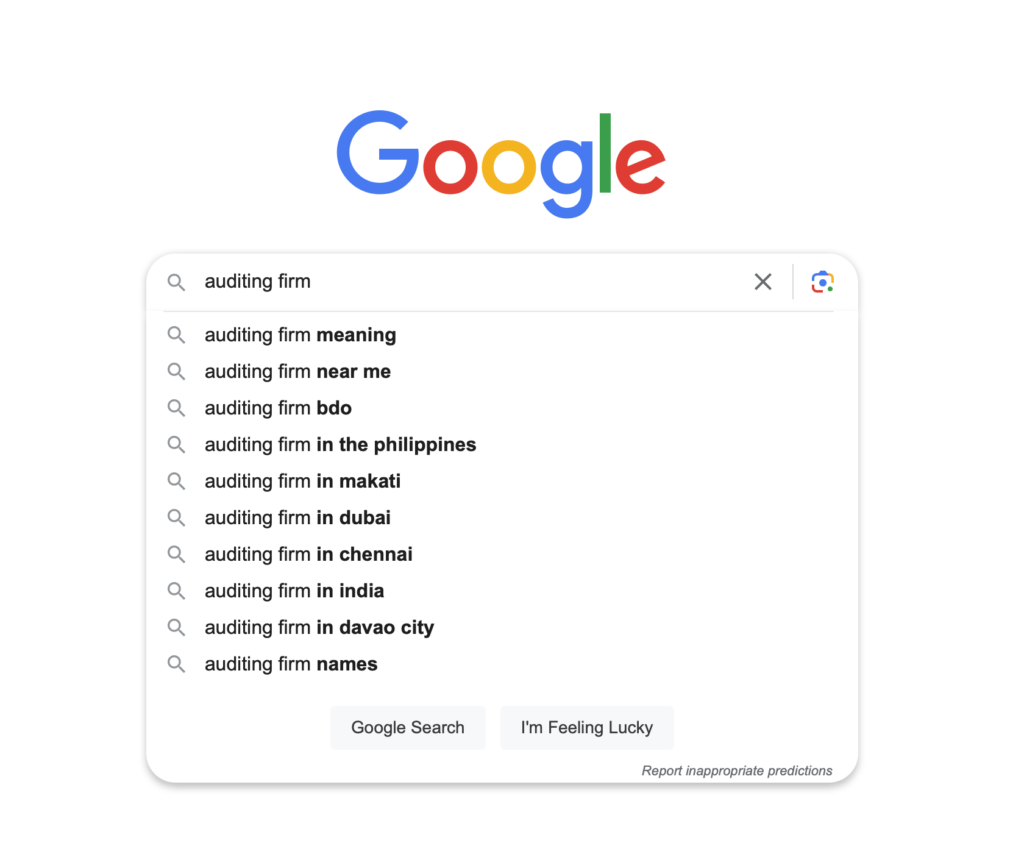
As you can see “auditing firm near me” is in the drop-down list of 10 and would reasonably be searched by someone looking to hire an auditing firm, and is not so competitive that we could not rank for it within 24 months.
Once you have selected a list of keywords, assign each keyword to a page type that matches the intent of that keyword.
Assigning the Correct Page Type for Each Keyword
Imagine if you Googled “Tickets to Six Flags”, and clicked on the top website reading with the title “Six Flags Tickets”, but the page you went to was an FAQ page about the ticket purchasing process. Is this page technically about tickets to Six Flags? Yes. Is this page most likely what you were searching for? No. Most likely, you were looking for the page to purchase tickets to the park.
Just like in that simple example, each keyword you select needs a different type of page to match the visitor’s search intent based on their level of awareness.
Level of Awareness and Page Types
| Level of Awareness | Example Keywords |
|---|---|
| Unaware |
Typically, these keywords have too vague of search intent for us to target. |
| Problem Aware | Blog article |
| Solution Aware | Blog article, Comparison page, Product/service page |
| Product Aware | Industry Page, Use Case Page, Product/service page |
| Most Aware | About page, Testimonials page, Contact page |
Keep in mind that this is only a recommendation. First and foremost, you should select the page type that will best fit with the intent of the potential client’s search keyword. Our recommended content for each page is as follows:
Blog Article
- Estimated read time
- 3-5 bullet points summarizing the contents of the article
- A brief introduction leading right into the content of the piece
- Visual aids conveying the main value of the blog
- Distinct sections separated by headers
Comparison Page
- Table breaking down primary features or ranking algorithm for each topic being compared
- Explanation of ranking in summary below the main table
- Other related mini-lists focused on peripheral but related content for added value
Product/Service Page
- Value proposition clearly stated in headline followed by content expanding on the value proposition
- Case studies or client testimonials
- Customer logos or awards
- Graphical breakdowns of processes when necessary
Industry Page
- Headline coneys how your firm serves customers in that industry
- Logos/testimonials of customers in that industry
- Graphical element highlighting tangible results for clients in that industry
- Industry case study
Use Case Page
- Headline describes how your service fits the use case
- A clear breakdown of the issues your potential clients face and how you solve each one
- Awards and accreditations relevant to the use case
About Page
- History of the company and its founders (if applicable)
- Pictures of employees and the office
- Logos or mentions of customers
- Full address
Testimonials Page
- Videos of clients if possible
- Bullet points of results achieved for each client
- Sorting mechanism by industry or service
Contact Page
- Firm phone number
- Email addresses for specific individuals in the firm
- Firm mailing address
- Contact us form
Once you have mapped out your keywords to the correct page type to match search intent, create the pages with high-converting, thought leadership content.
Writing High-Converting, Thought Leadership Content
Ensuring your pages convert is the next major step. If you are not satisfying search intent adequately with easy-to-read and understand pages, you will only see an uptick in traffic, but not conversions. Below, we’ve listed a few methods of making your pages stand apart from the competition.
Technical Depth
The content you publish should be sufficiently technical where it is clear you are a thought leader in your industry and know about your potential client’s problems and the best way to solve them at a deeper level than your competitors. This could mean detailing tax laws relating specifically to a particular industry you serve, or breaking down your audit process compared to your competitors.
Your content should provide value immediately with little to no fluff at the beginning of your pages. Doing so makes your visitors more likely to pursue more research into your firm or consider opening the conversation.
Graphical Elements
Graphical elements that allow a reader to understand the message you are conveying without reading many words boosts your page’s relevance. Below are some recommended elements:
| Element | Use Case |
|---|---|
| Table |
A table should be used for comparison purposes to help a reader ascertain the various topics being discussed. |
| Graph |
Graphs are beneficial for displaying quantitative data, especially over a period of time. |
| Process Diagram |
Process diagrams, typically flowcharts or similar elements, are used to display a process you recommend or perform. |
| Image |
Images are fantastic elements to break up text and provide memorable elements to describe the surrounding content. |
You should ensure that at least one graphical element is above the fold at any given time to avoid overbearing the reader with text.
Skimmable Format
In an ideal world, you readers sit down and read your entire page. However, most people will skim. Ensure your page can be easily skimmed by:
- Reduce paragraph lengths to no more than 4-6 sentences
- Utilize bullet points and numbered lists to break up the page
- Separate contents and subjects with headers
Be sure to try scrolling through your page yourself and make mental notes of where your eyes are drawn to and if any part of the page is too text-heavy.
Next Steps for Accounting Firms
I hope that you have found this guide beneficial. If your firm doesn’t have the resources or desire to execute this strategy in-house, don’t hesitate to reach out for an SEO audit and for more information about our services.