The average AI implementation cost is $6,240 in the first year for an off-the-shelf AI tool and $76,837 for a custom-built AI project in 2026. Most small businesses land between the two: companies with 1 to 10 employees spend $9,860 a year on AI, and companies with 11 to 50 employees spend $27,430. Enterprises with 1,001 to 5,000 employees spend $412,560.
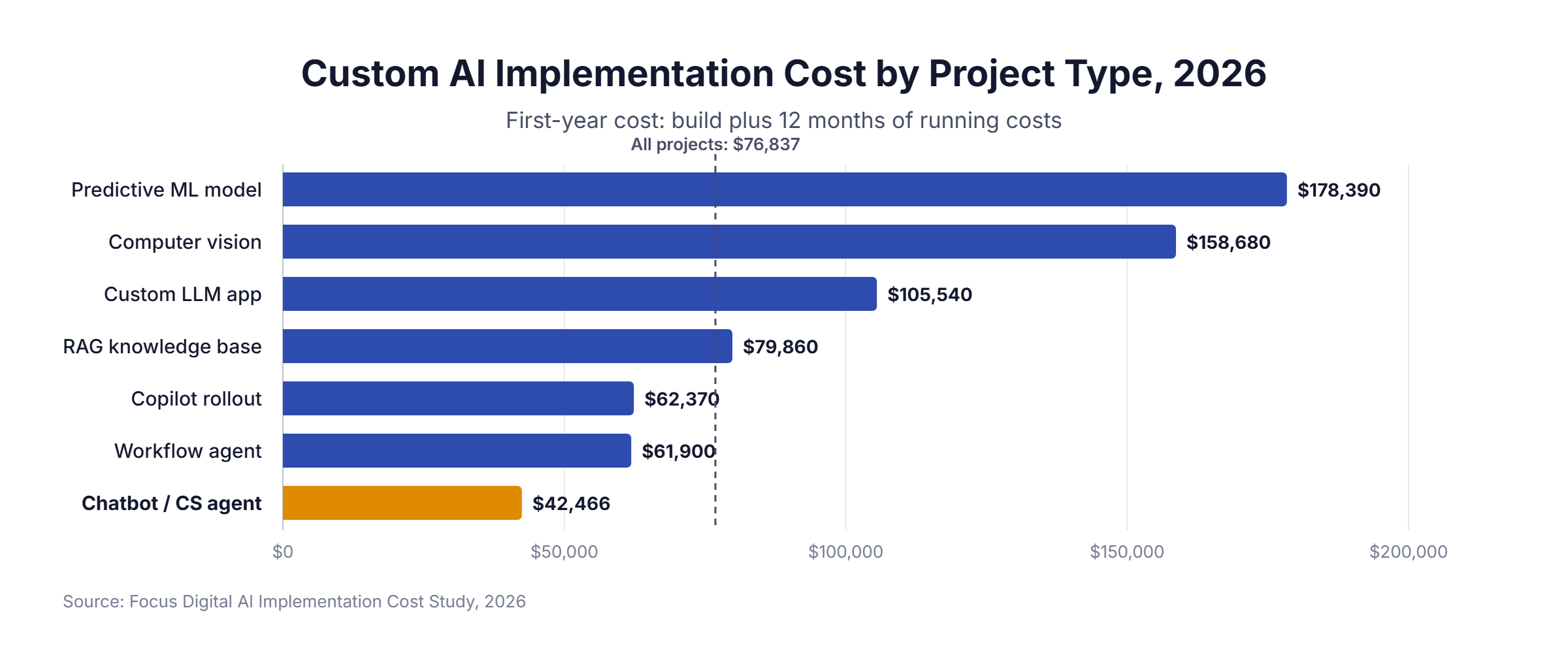
We define AI implementation as any business putting AI to work in its operations, from paid seats on an AI tool to a custom system built on its own data. A custom project’s first-year cost covers the build plus 12 months of running costs, and custom builds range from $42,466 for a chatbot to $178,390 for a predictive machine learning (ML) model.
| AI implementation tier | First-year cost |
|---|---|
| Off-the-shelf AI tool | $6,240 |
| Small business (1 to 10 employees) | $9,860 |
| Small business (11 to 50 employees) | $27,430 |
| Custom-built AI project | $76,837 |
| Enterprise (1,001 to 5,000 employees) | $412,560 |
We studied AI implementation cost by project type, company size, build path, industry, consultant rate, and budget category.
Key Takeaways
- A custom-built AI project costs $76,837 in its first year, 6.83% less than $82,475 in 2025.
- Custom AI projects launch in 9.19 weeks on average and pay back in 10.01 months.
- An off-the-shelf AI tool costs $6,240 in year one, 90.88% less than a custom build from an AI agency.
- Running costs average $1,723 a month, 26.89% of the first-year total.
- Data preparation takes 22.87% of the average build budget, up from 21.36% in 2025.
- Maintenance adds 18.63% of the build cost every year after launch.
Contents:
- Benchmarks: AI implementation cost by project type, API cost by model, the change from 2025, and what a reasonable budget is
- Breakdowns: company size, build path, industry, consultant rates, and where the budget goes
- How to budget: why AI projects go over budget, how to lower the cost, and payback time
Custom AI Implementation Cost by Project Type
The table below shows the build cost range, typical build cost, monthly running cost, first-year total, and launch time for the seven most common custom AI projects.
| Project type | Build cost range | Typical build cost | Monthly running cost | First-year cost | Weeks to launch |
|---|---|---|---|---|---|
| AI chatbot or customer service agent | $8,000 to $90,000 | $34,750 | $643 | $42,466 | 6.4 |
| AI agent or workflow automation | $12,000 to $120,000 | $47,860 | $1,170 | $61,900 | 8.7 |
| Enterprise copilot rollout (100 seats) | $15,000 to $60,000 | $27,930 | $2,870 | $62,370 | 5.3 |
| RAG knowledge base | $25,000 to $150,000 | $61,380 | $1,540 | $79,860 | 10.1 |
| Custom LLM app built on an API | $30,000 to $180,000 | $78,420 | $2,260 | $105,540 | 12.3 |
| Computer vision system | $40,000 to $250,000 | $118,240 | $3,370 | $158,680 | 17.2 |
| Predictive analytics or ML model | $60,000 to $400,000 | $143,710 | $2,890 | $178,390 | 18.6 |
| All custom AI projects | $56,158 | $1,723 | $76,837 | 9.19 |
Key findings:
- A copilot rollout costs more to run than to build. Seat fees make up 55.21% of a 100-seat copilot rollout’s first year, compared with 18.16% for a chatbot. We believe most buyers price the enablement work and forget that the seat bill will arrive monthly after launch.
- Projects that touch your own data take two to three times as long. A retrieval-augmented generation (RAG) knowledge base takes 10.1 weeks to launch and a predictive ML model takes 18.6, compared with 5.3 weeks for a copilot rollout. Our read is that the build itself moves fast now, and the weeks are spent on finding, cleaning, and permissioning the data.
- Workflow agents cost 45.76% more than chatbots in year one. An agent takes actions inside your other systems, and every connected system adds integration and testing hours.
AI API Cost by Model: Monthly Running Cost
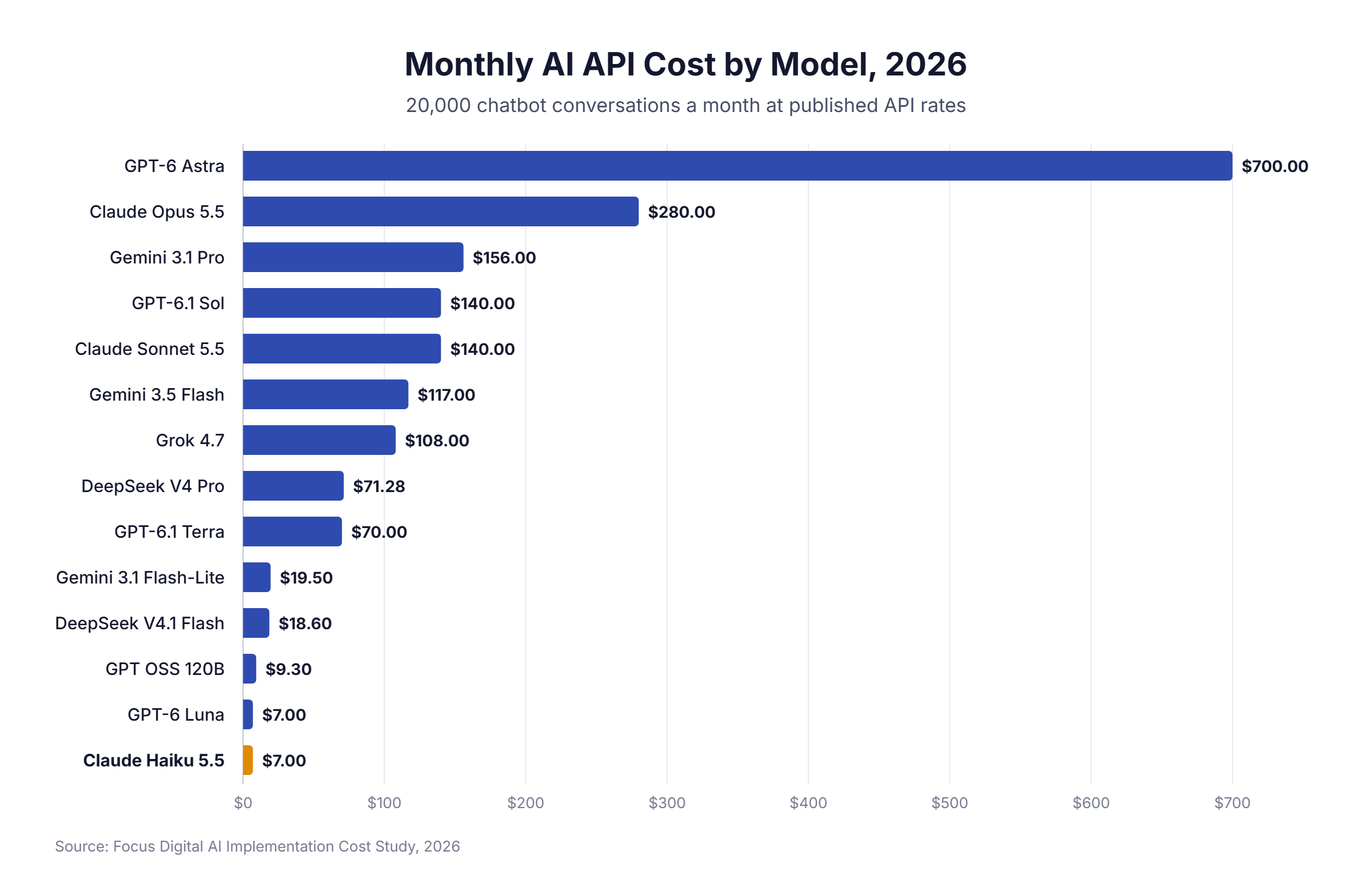
Model calls are the part of the running bill you control most directly. The table below prices one customer service chatbot workload on each major model at three volumes, using each vendor’s published API rates. Each conversation uses about 1,500 input tokens and 400 output tokens.
| Model | Vendor | Input per 1M tokens | Output per 1M tokens | Small business (2,000 conversations a month) | Mid-size (20,000 a month) | Enterprise (200,000 a month) |
|---|---|---|---|---|---|---|
| GPT-6 Astra | OpenAI | $10.00 | $50.00 | $70.00 | $700.00 | $7,000.00 |
| Claude Opus 5.5 | Anthropic | $4.00 | $20.00 | $28.00 | $280.00 | $2,800.00 |
| Gemini 3.1 Pro | $2.00 | $12.00 | $15.60 | $156.00 | $1,560.00 | |
| GPT-6.1 Sol | OpenAI | $2.00 | $10.00 | $14.00 | $140.00 | $1,400.00 |
| Claude Sonnet 5.5 | Anthropic | $2.00 | $10.00 | $14.00 | $140.00 | $1,400.00 |
| Gemini 3.5 Flash | $1.50 | $9.00 | $11.70 | $117.00 | $1,170.00 | |
| Grok 4.7 | xAI | $2.00 | $6.00 | $10.80 | $108.00 | $1,080.00 |
| DeepSeek V4 Pro | DeepSeek | $1.32 | $3.96 | $7.13 | $71.28 | $712.80 |
| GPT-6.1 Terra | OpenAI | $1.00 | $5.00 | $7.00 | $70.00 | $700.00 |
| Gemini 3.1 Flash-Lite | $0.25 | $1.50 | $1.95 | $19.50 | $195.00 | |
| DeepSeek V4.1 Flash | DeepSeek | $0.30 | $1.20 | $1.86 | $18.60 | $186.00 |
| GPT OSS 120B | Open-weight (Groq) | $0.15 | $0.60 | $0.93 | $9.30 | $93.00 |
| GPT-6 Luna | OpenAI | $0.10 | $0.50 | $0.70 | $7.00 | $70.00 |
| Claude Haiku 5.5 | Anthropic | $0.10 | $0.50 | $0.70 | $7.00 | $70.00 |
What the Model Cost Data Shows
- Model choice changes the bill 100 times over: At 20,000 conversations a month, GPT-6 Astra costs $700.00 and Claude Haiku 5.5 or GPT-6 Luna cost $7.00 for the same traffic. Flagship models average $311.00 a month at that volume, against $12.28 for budget models.
- Model calls are a small slice of running cost until volume climbs: A mid-tier model such as Claude Sonnet 5.5 costs $140.00 a month at 20,000 conversations, 8.12% of the $1,723 average monthly running cost. Hosting, the vector database, monitoring, and upkeep make up the rest. At 200,000 conversations, a flagship model alone runs $7,000.00 a month, 4.06 times the average running cost.
- Budget models handle most routine traffic: FAQ answers, order status, intake forms, and classification work well on Haiku, Luna, Flash-Lite, or an open-weight model. We think flagship models earn their price on multi-step reasoning, agent tasks that act in other systems, and answers a customer will hold you to. Most production systems route by request type, so the blended cost lands close to the budget tier.
- Output tokens drive the price: Output costs five times input on OpenAI and Anthropic models, so a chatbot that writes long answers costs more than one that answers in two sentences.
How AI Implementation Cost Changed From 2025 to 2026
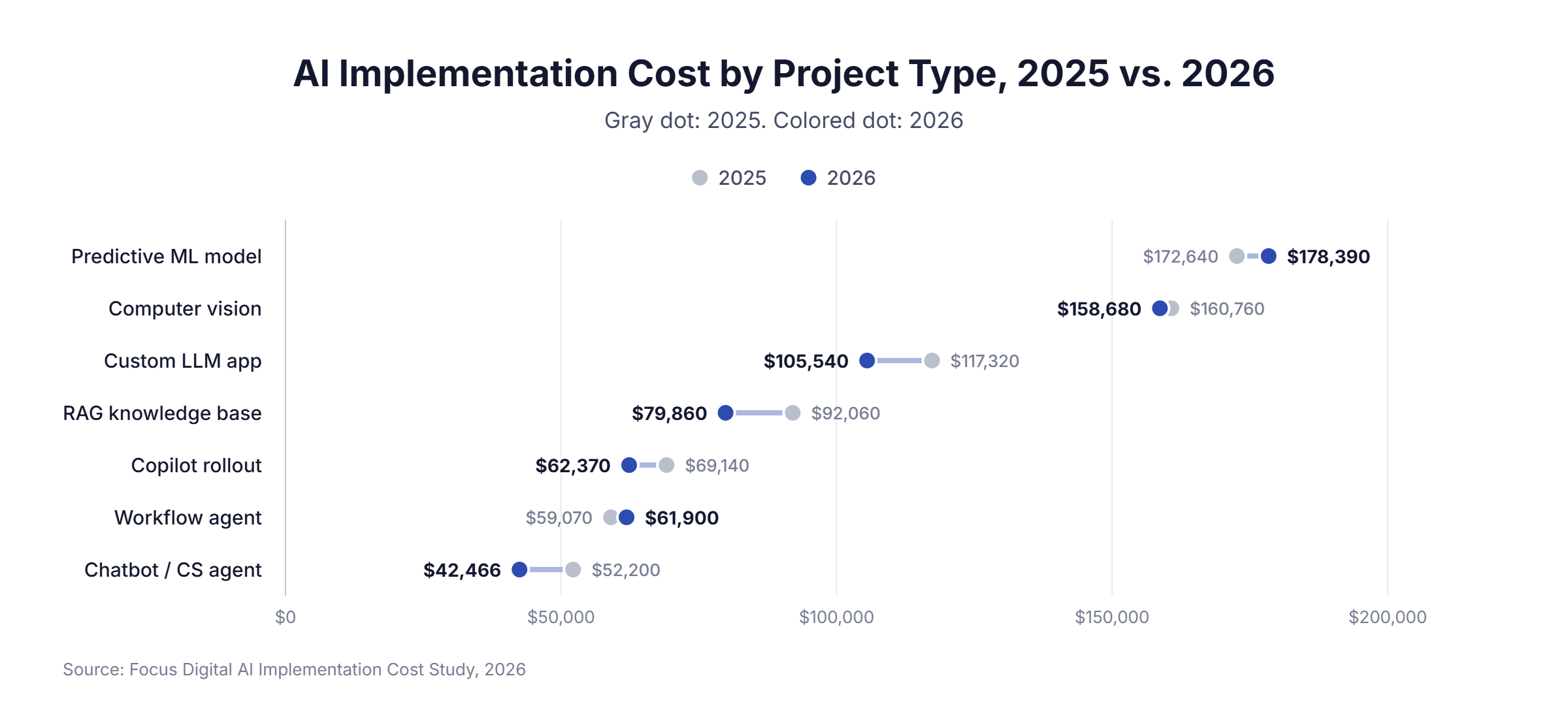
The average first-year cost of a custom AI project fell 6.83% from 2025 to 2026. The table shows the change for each project type and the share of first-year cost that goes to running costs.
| Project type | 2025 | 2026 | Change | Running cost share of year one |
|---|---|---|---|---|
| AI chatbot or customer service agent | $52,200 | $42,466 | -18.64% | 18.16% |
| RAG knowledge base | $92,060 | $79,860 | -13.25% | 23.14% |
| Custom LLM app built on an API | $117,320 | $105,540 | -10.04% | 25.69% |
| Enterprise copilot rollout (100 seats) | $69,140 | $62,370 | -9.79% | 55.21% |
| Computer vision system | $160,760 | $158,680 | -1.29% | 25.48% |
| Predictive analytics or ML model | $172,640 | $178,390 | +3.33% | 19.44% |
| AI agent or workflow automation | $59,070 | $61,900 | +4.79% | 22.68% |
| All custom AI projects | $82,475 | $76,837 | -6.83% | 26.89% |
Key findings:
- Cheaper models cut the running cost of chatbots. A chatbot’s monthly running cost fell from $910 to $643. Small models now answer routine questions for a fraction of 2025 token prices, and chatbots send most of their traffic to small models.
- Agents and predictive models got more expensive. Workflow agents rose 4.79% and predictive ML models rose 3.33%. We think buyers now ask agents to finish whole jobs, so each build connects to more systems than a 2025 agent did.
- Copilot seat prices came down. Microsoft 365 Copilot Business lists at $21 per user per month, with a promotional price of $18, and ChatGPT Business and Claude Team both list at $20 billed annually. Those prices brought the first-year cost of a 100-seat rollout down 9.79%.
What Is a Reasonable AI Implementation Budget?
A reasonable first-year budget falls inside the typical column below. Lean projects cost 38.27% less than typical projects, and the main difference is scope. High-end projects cost 48.26% more and usually involve regulated data or several connected systems.
| Project type | Lean (bottom 25%) | Typical | High end (top 25%) |
|---|---|---|---|
| AI chatbot or customer service agent | Under $26,214 | $42,466 | $62,960 or more |
| AI agent or workflow automation | Under $38,211 | $61,900 | $91,773 or more |
| Enterprise copilot rollout (100 seats) | Under $38,501 | $62,370 | $92,470 or more |
| RAG knowledge base | Under $49,298 | $79,860 | $118,400 or more |
| Custom LLM app built on an API | Under $65,150 | $105,540 | $156,474 or more |
| Computer vision system | Under $97,953 | $158,680 | $235,259 or more |
| Predictive analytics or ML model | Under $110,120 | $178,390 | $264,481 or more |
Our read on these ranges: a quote below the lean column usually leaves out data cleanup or integration, and a quote above the high-end column usually bundles a second project into the first.
AI Implementation Cost by Company Size
Larger companies spend more on AI because they build custom systems for more users. The table shows the average first-year spend on AI projects and the share of companies that use only off-the-shelf AI tools.
| Company size | 2025 | 2026 | Change | Uses only off-the-shelf tools |
|---|---|---|---|---|
| 1 to 10 employees | $11,240 | $9,860 | -12.27% | 71.38% |
| 11 to 50 employees | $29,170 | $27,430 | -5.96% | 54.62% |
| 51 to 200 employees | $63,880 | $68,710 | +7.56% | 37.91% |
| 201 to 1,000 employees | $151,460 | $164,380 | +8.53% | 22.47% |
| 1,001 to 5,000 employees | $386,920 | $412,560 | +6.62% | 13.06% |
| 5,001+ employees | $1,093,470 | $1,186,290 | +8.48% | 6.83% |
Key findings:
- Small businesses spent less in 2026. Companies with 1 to 10 employees spent $9,860 in 2026, 12.27% less than in 2025, and 71.38% of them use only packaged tools. We believe cheaper seats let small teams skip custom builds altogether.
- Spend climbs with company size from 51 employees up. Every size band above 50 employees spent more in 2026, led by 201 to 1,000 employees at 8.53%. Mid-size companies tend to be the ones moving pilots into production this year.
AI Implementation Cost by Build Path
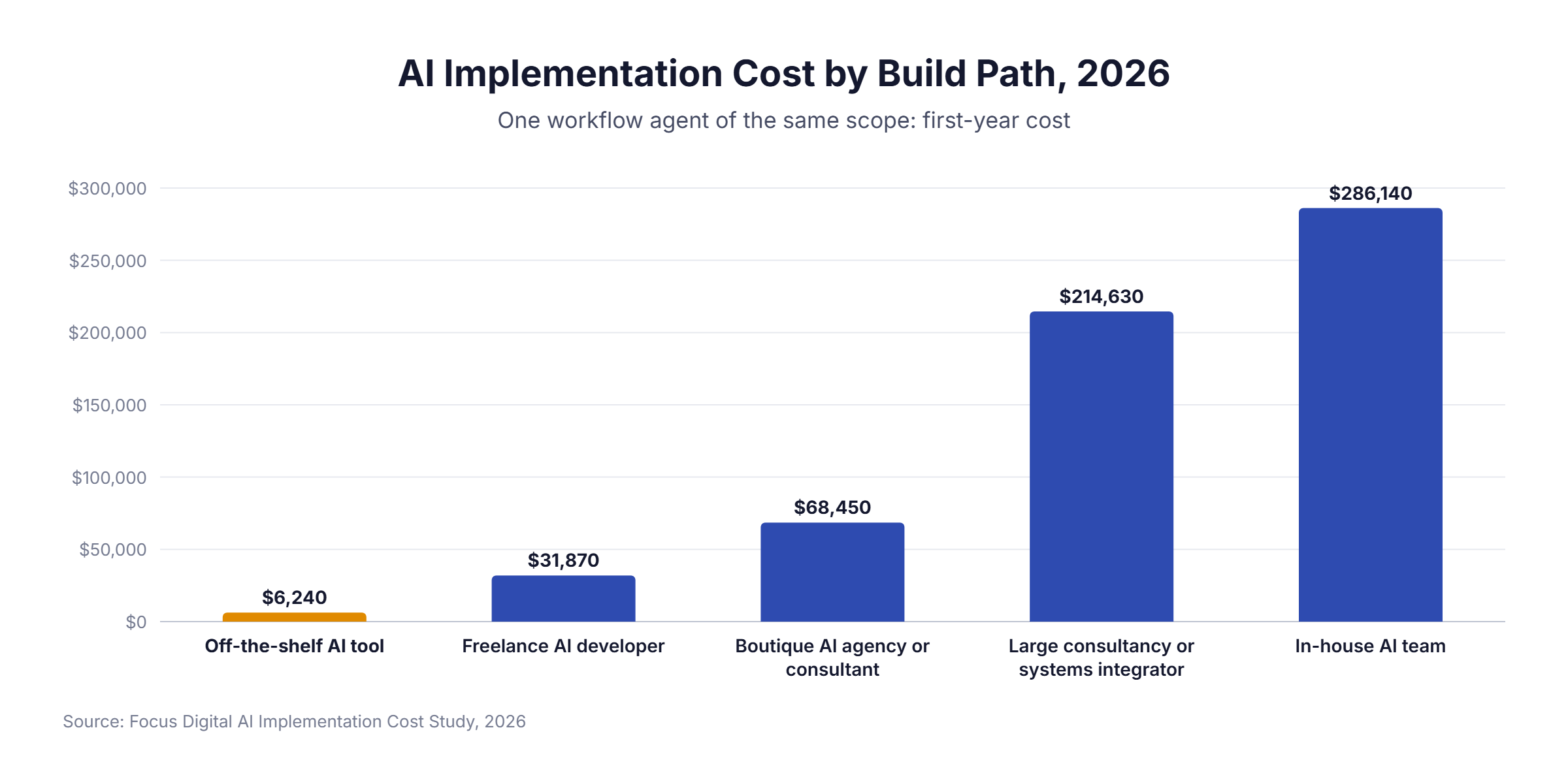
The same workflow agent costs very different amounts depending on who builds it. The table compares first-year cost, launch time, and the share of projects that reach production for each build path.
| Build path | 2025 | 2026 | Change | Weeks to launch | Projects that reach production |
|---|---|---|---|---|---|
| Off-the-shelf AI tool (SaaS) | $6,870 | $6,240 | -9.17% | 2.4 | 81.36% |
| Freelance AI developer | $34,210 | $31,870 | -6.84% | 7.6 | 48.92% |
| Boutique AI agency or consultant | $71,930 | $68,450 | -4.83% | 9.3 | 67.14% |
| Large consultancy or systems integrator | $206,480 | $214,630 | +3.94% | 16.8 | 58.27% |
| In-house AI team | $271,590 | $286,140 | +5.35% | 21.4 | 44.73% |
Key findings:
- Boutique agencies reach production more often than freelancers. 67.14% of boutique agency projects reach production, compared with 48.92% of freelance projects. The most likely explanation is that agencies plan for integration and handoff, and a solo developer often stops at a working demo.
- In-house teams cost the most and launch the slowest. An in-house team spends $286,140 and 21.4 weeks on the same agent a boutique agency ships for $68,450 in 9.3 weeks. Salaries for AI engineers make up most of that difference, and a first project rarely keeps a full team busy.
- Large consultancies and in-house teams got more expensive. Large consultancy projects rose 3.94% and in-house builds rose 5.35%, while the other three build paths got cheaper. We think enterprise buyers still pay for brand and risk transfer on their first AI project.
AI Implementation Cost by Industry
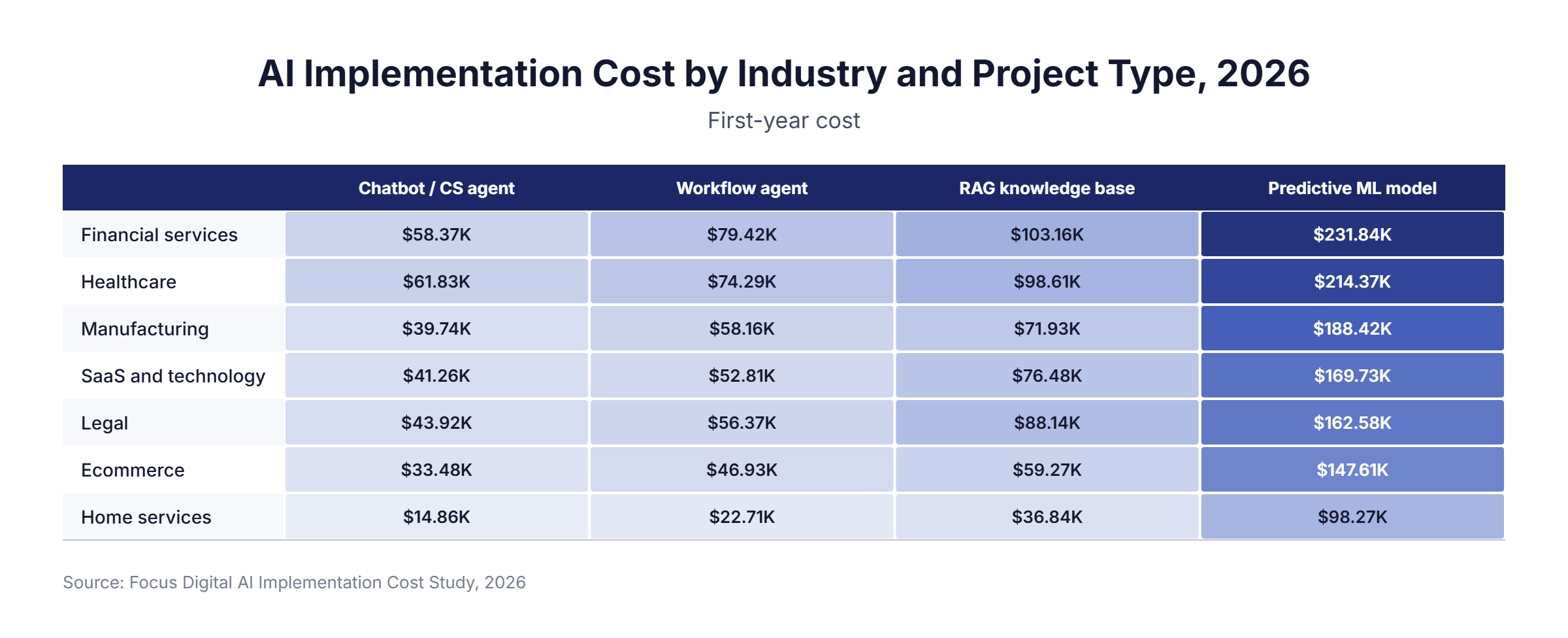
Regulated industries pay the most for AI because security and compliance work adds to every build. The table shows the average first-year cost, the compliance premium, and the most common first AI project in each industry.
| Industry | 2025 | 2026 | Change | Compliance premium | Most common first project |
|---|---|---|---|---|---|
| Financial services | $124,380 | $131,760 | +5.93% | 28.84% | Document review and fraud scoring |
| Healthcare | $109,270 | $118,460 | +8.41% | 31.27% | Patient intake and scheduling agent |
| Manufacturing | $98,140 | $104,590 | +6.57% | 11.43% | Predictive maintenance model |
| SaaS and technology | $81,760 | $86,210 | +5.44% | 6.52% | Support agent built on product docs |
| Legal | $66,930 | $72,380 | +8.14% | 17.66% | Contract review on a RAG knowledge base |
| Ecommerce | $57,140 | $54,930 | -3.86% | 4.18% | Product Q&A and order-status chatbot |
| Home services | $23,860 | $21,470 | -10.01% | 2.36% | After-hours call and booking agent |
Key findings:
- Healthcare carries the largest compliance premium. Healthcare projects cost 31.27% more than the same build in an unregulated industry. HIPAA review, audit logging, and signed business associate agreements with every vendor add hours to each project.
- Home services gets the most AI for the least money. A home services company spends $21,470 in year one, and the most common first project is an after-hours call and booking agent. In our work with home services clients, a missed after-hours call is a lost job, so a booking agent pays for itself quickly.
- Ecommerce and home services were the only industries to spend less in 2026. Both lean on off-the-shelf chatbots, and chatbot costs fell 18.64% this year.
AI Consultant Hourly Rates by Region
AI consultant rates vary about five times over between the United States and India. The table shows median hourly rates for 2025 and 2026 and the typical range in each region.
| Region | 2025 | 2026 | Change | Typical range |
|---|---|---|---|---|
| United States | $179 | $187 | +4.46% | $110 to $350 |
| United Kingdom | $161 | $168 | +4.34% | $95 to $310 |
| Western Europe | $147 | $154 | +4.76% | $85 to $280 |
| Canada | $143 | $149 | +4.19% | $85 to $260 |
| Eastern Europe | $69 | $73 | +5.79% | $40 to $130 |
| Latin America | $57 | $61 | +7.01% | $35 to $115 |
| India | $34 | $37 | +8.82% | $22 to $75 |
Key findings:
- Rates rose in every region. Median rates climbed between 4.19% and 8.82%, with the largest increase in India. We believe demand for engineers who have shipped agents to production grew faster than the supply.
- Eastern Europe costs 60.96% less than the United States. Nearshore teams in Eastern Europe and Latin America work in overlapping time zones, which keeps the savings from disappearing into slow handoffs.
Where an AI Implementation Budget Goes
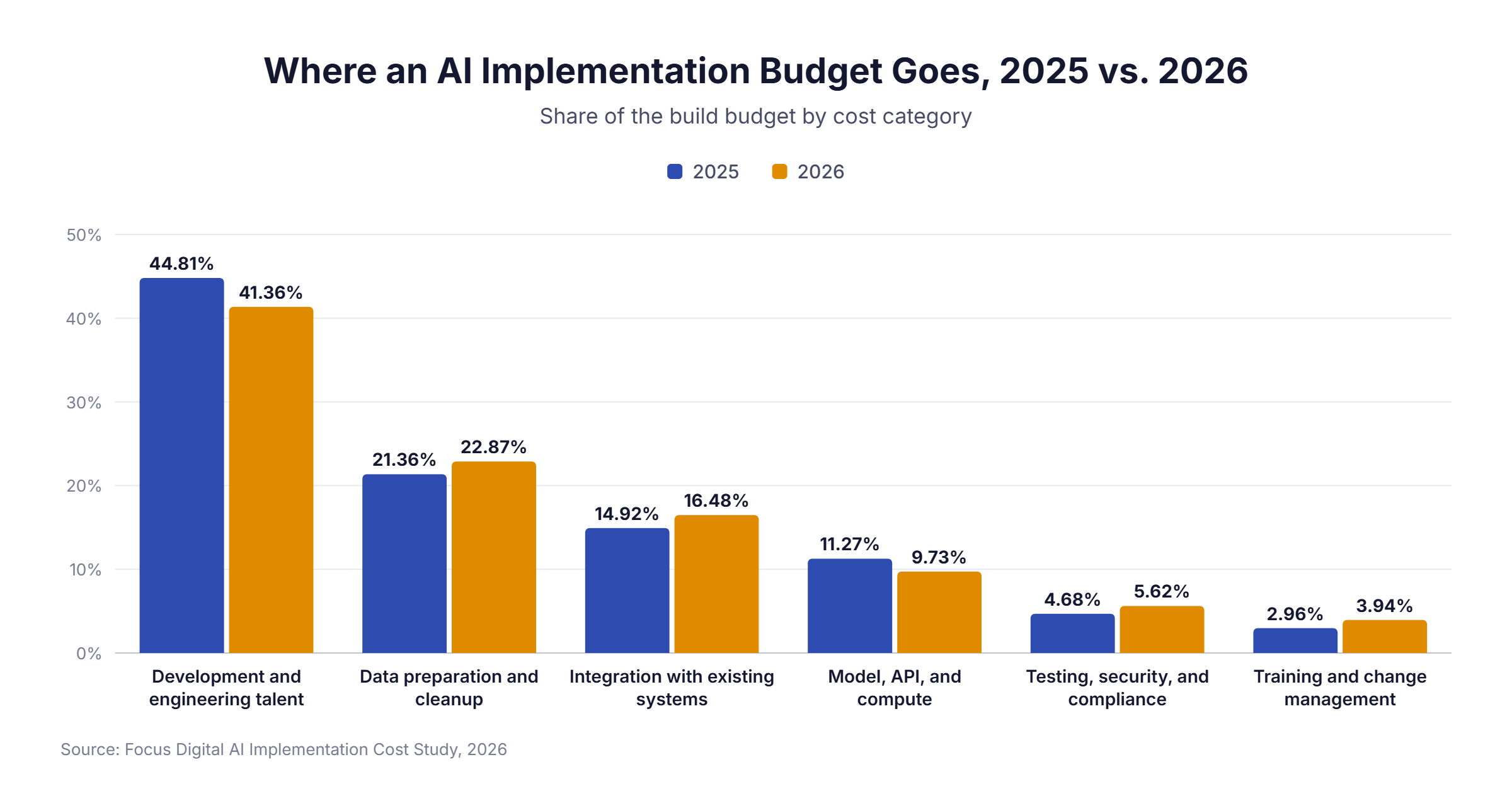
Talent is still the largest line item in an AI build, but data preparation and integration took a larger share in 2026. The table shows each category’s share of the build budget.
| Cost category | 2025 | 2026 | Change (points) |
|---|---|---|---|
| Development and engineering talent | 44.81% | 41.36% | -3.45 |
| Data preparation and cleanup | 21.36% | 22.87% | +1.51 |
| Integration with existing systems | 14.92% | 16.48% | +1.56 |
| Model, API, and compute | 11.27% | 9.73% | -1.54 |
| Testing, security, and compliance | 4.68% | 5.62% | +0.94 |
| Training and change management | 2.96% | 3.94% | +0.98 |
Key findings:
- Model costs shrank to 9.73% of the budget. Token prices fell faster than any other input, so the model itself is now one of the cheaper parts of a build.
- Training and change management grew the fastest. The share rose from 2.96% to 3.94%. We believe companies learned in 2025 that an AI tool nobody on the team uses returns nothing.
- Maintenance adds 18.63% of the build cost each year after launch. The rate fell from 19.84% in 2025. Budget for year two before you sign the build contract.
Why AI Projects Go Over Budget
Close to half of enterprises spent more on AI than they planned in 2026. The table shows the most common causes of overruns, the share of over-budget projects each cause explains, and how much it adds to the cost.
| Cause | Share of over-budget projects | Adds to project cost |
|---|---|---|
| The data needed more cleanup than planned | 34.61% | 27.43% |
| The pilot grew into a production build | 26.17% | 41.86% |
| Inference costs grew with usage | 17.32% | 22.58% |
| Legacy systems took longer to connect | 13.49% | 18.37% |
| Security and compliance review came late | 8.41% | 29.14% |
Key findings:
- Scope growth adds the most cost. A pilot that grows into a production build adds 41.86%, more than any other cause. Production systems need monitoring, permissions, and fallbacks that a pilot does not.
- Data cleanup is the most common cause of running over budget. 34.61% of over-budget projects trace back to messy data. Our read is that most companies have never audited the documents and records they plan to feed an AI system.
How to Lower AI Implementation Cost
Each change below targets one of the causes above. The last column shows how much each change cuts first-year cost, based on the paired figures in this study.
| Do this | What it fixes | Cuts first-year cost by up to |
|---|---|---|
| Buy an off-the-shelf tool before you build | Custom builds for jobs a packaged tool already does | 90.88% |
| Hire a freelancer for a single workflow | Enterprise consulting rates on a small build | 85.15% |
| Ship one workflow first, then expand | Pilots that grow into production builds | 69.27% |
| Clean and label your data before kickoff | Data cleanup the budget never planned for | 27.43% |
| Use nearshore engineers for build work | Top US rates on every hour of build work | 25.21% |
| Route routine requests to a small model | Inference bills that grow with usage | 13.98% |
| Batch non-urgent model calls | Real-time prices for overnight jobs | 9.18% |
We believe the order of these steps counts as much as the steps themselves. Start with a packaged tool, prove the use case, and only then pay for a custom build of one workflow.
How Long AI Takes to Pay for Itself
The average custom AI project pays back its first-year cost in 10.01 months. The table shows payback time for each project type.
| Project type | First-year cost | Months to pay back |
|---|---|---|
| AI agent or workflow automation | $61,900 | 6.3 |
| AI chatbot or customer service agent | $42,466 | 7.6 |
| RAG knowledge base | $79,860 | 9.7 |
| Enterprise copilot rollout (100 seats) | $62,370 | 11.4 |
| Custom LLM app built on an API | $105,540 | 13.6 |
| Predictive analytics or ML model | $178,390 | 16.2 |
| Computer vision system | $158,680 | 18.9 |
| All custom AI projects | $76,837 | 10.01 |
Key findings:
- Workflow agents pay back the fastest at 6.3 months. An agent removes hours of manual work on day one, while a predictive model needs months of decisions before its value shows up.
- Copilot rollouts take 11.4 months to pay back. Seat fees start on day one, and adoption across a team usually takes a quarter or more.
How These Figures Are Calculated
- First-year cost: typical build cost + (monthly running cost × 12)
- AI implementation: any business use of AI in its operations, from paid seats on an off-the-shelf tool to a custom system built on company data
- Average custom AI project: each custom project type’s first-year cost weighted by how often companies choose that project type
- Monthly model cost: conversations per month × (1,500 input tokens × input price + 400 output tokens × output price) ÷ 1,000,000, using each vendor’s standard published API rate in November 2026 (peak rate for DeepSeek, prompts under 100,000 tokens for Claude Haiku)
- Year-over-year change: (2026 figure ÷ 2025 figure − 1) × 100
- Cost cuts: (1 − lower-cost option ÷ higher-cost option) × 100, using paired figures from this study; model-call savings apply the share of running cost spent on model calls
Further Reading
To request the full data set behind this study, contact Focus Digital.
About the Data
This study covers seven AI project types across six company sizes, five build paths, seven industries, and seven regions, for 2025 and 2026.
Sources
(18)
- 1. Focus Digital AI Implementation Cost Study, 2026. A compilation of published consultant rate cards, vendor list prices, and AI cost benchmark surveys, aligned to 2025 and 2026 project scopes and checked against Focus Digital’s own agentic and automation builds.
- 2. Redress Compliance, Microsoft 365 Copilot Pricing 2026 (Copilot enterprise, Business, and E7 list prices)
- 3. eesel AI, ChatGPT for Work Pricing (ChatGPT Business and Enterprise seat prices)
- 4. Runbear, Claude Enterprise Pricing 2026 (Claude Team and Enterprise seats, API token prices)
- 5. Futurum Group, 2H 2026 CIO and Technology Buyers Survey (share of enterprises over AI budget)
- 6. THE Journal, Gartner: Half of Gen AI Projects Could Exceed Budget by 2028 (overrun causes, inference share of lifetime cost)
- 7. CFO Dive, One in Four Firms Miss AI Cost Projections by 50% or More (forecast misses, data cost drivers)
- 8. Keyhole Software, AI Development Cost in 2026 (build ranges, budget split, maintenance)
- 9. Groovy Web, AI Consulting Rates 2026 (hourly rates by region, seniority, and firm type)
- 10. Deloitte, AI ROI: The Paradox of Rising Investment and Elusive Returns (payback timing)
- 11. PYMNTS, The Enterprise AI Payback Curve (enterprise payback expectations)
- 12. Clarify Capital, Small Business AI Spending (small business AI adoption and spend growth)
- 13. OpenAI, API Pricing (GPT-6 Astra, GPT-6.1 Sol, GPT-6.1 Terra, and GPT-6 Luna token prices)
- 14. Anthropic, Claude API Pricing (Claude Opus 5.5, Sonnet 5.5, and Haiku 5.5 token prices)
- 15. Google, Gemini API Pricing (Gemini 3.1 Pro, 3.5 Flash, and 3.1 Flash-Lite token prices)
- 16. xAI, Grok 4.7 Model Documentation (Grok 4.7 token prices)
- 17. DeepSeek, Models and Pricing (DeepSeek V4 Pro and V4.1 Flash token prices)
- 18. Groq, Supported Models (GPT OSS 120B open-weight model token prices)