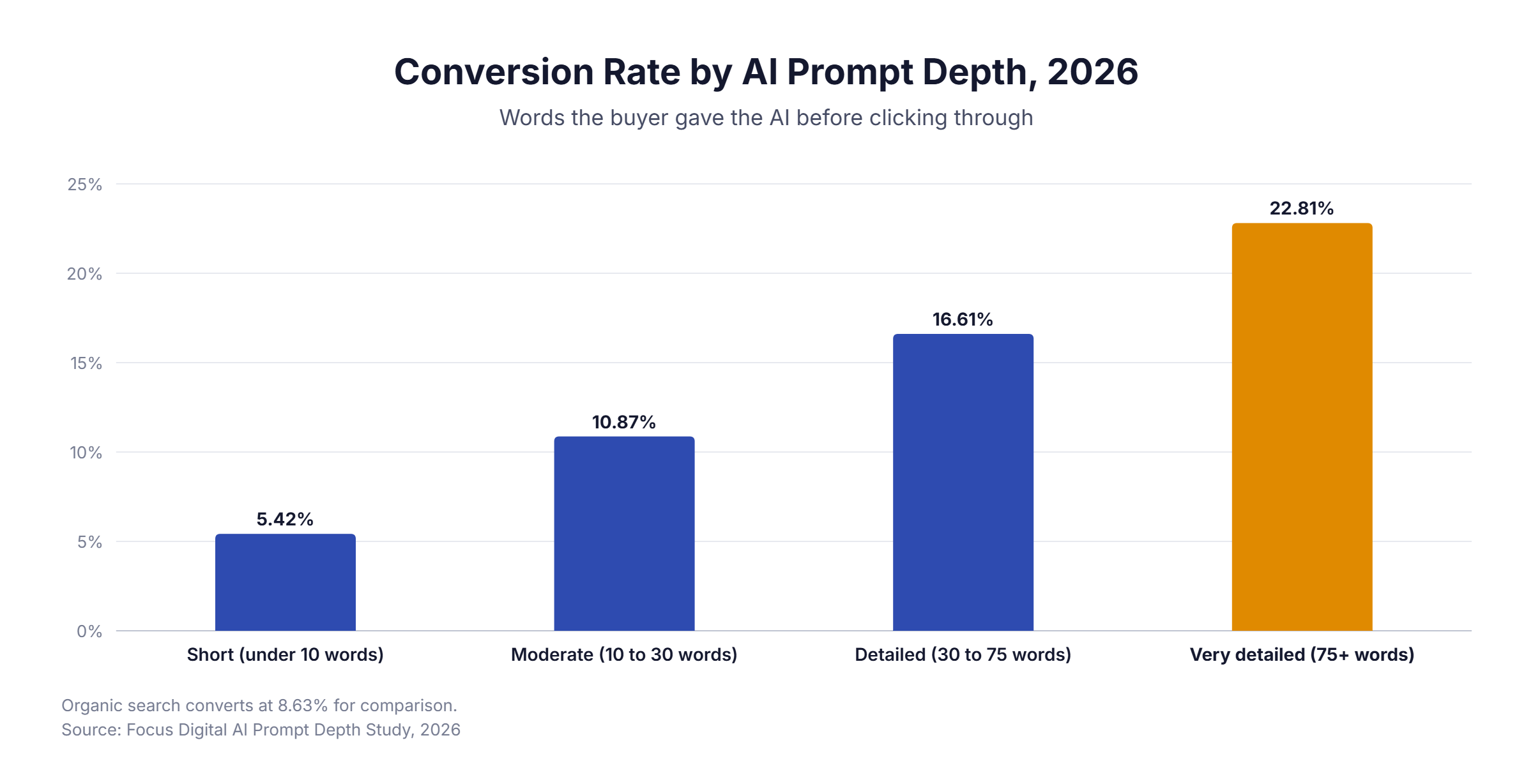
The average conversion rate by AI prompt depth climbs from 5.42% for prompts under 10 words to 22.81% for prompts of 75 or more words, 4.19 times higher. The average AI-referred visit converts at 9.55%, compared with 8.63% for organic search and 6.45% for paid search.
A detailed prompt gives the AI enough to filter on: budget, location, company size, and the exact problem. The answer comes back tailored, and the buyer who clicks already knows the company fits. We studied conversion rate by prompt depth, number of prompts, prompt details, industry, and AI assistant.
Key Takeaways
- Prompts of 75+ words convert at 22.81%, 4.19 times the 5.42% rate for prompts under 10 words.
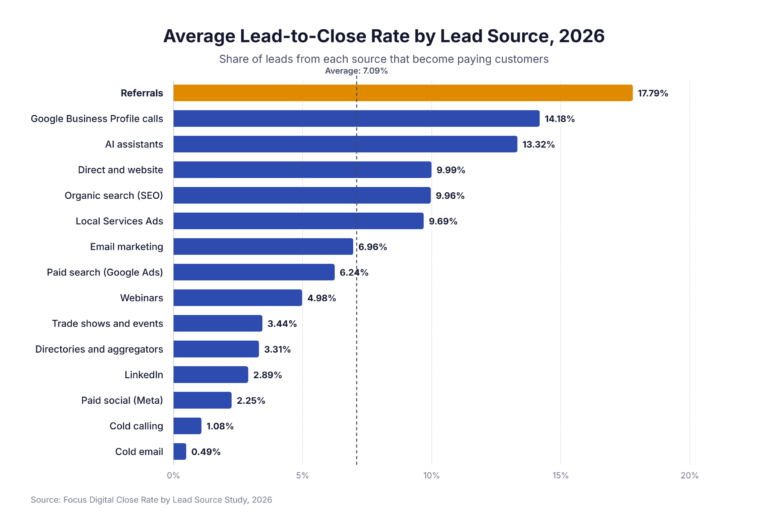
- Leads from 75+ word prompts close at 20.48%, 2.29 times the 8.91% close rate for short prompts.
- Detailed prompts (30+ words) drove 18.05% of AI-referred visits in 2026, up from 6.71% in 2025.
- A budget or price range in the prompt raises conversion rate by 47.36%, the most of any detail.
- Buyers who send 4 to 6 prompts before clicking convert at 15.51%, 107.89% more than one-prompt buyers.
- ChatGPT prompts that trigger a web search average 8.7 words, 2.39 times the length of a Google search.
Contents:
- Benchmarks: conversion rate by prompt depth, the 2025 to 2026 shift, and what a good AI conversion rate is
- Breakdowns: prompts before the click, prompt details, industry, AI assistant, and prompt length vs. Google
- How to win detailed prompts: why short prompts convert poorly and what to publish
Conversion Rate by AI Prompt Depth
The table below groups AI-referred visits by how many words the buyer gave the AI before clicking through, with each group’s conversion rate, close rate, and sales cycle.
| Prompt depth | Average words | Share of AI visits | Conversion rate | Vs. organic search | Share of AI leads | Lead-to-close rate | Average sales cycle |
|---|---|---|---|---|---|---|---|
| Short (under 10 words) | 6.4 | 48.21% | 5.42% | -37.22% | 27.36% | 8.91% | 29 days |
| Moderate (10 to 30 words) | 17.8 | 33.73% | 10.87% | +25.95% | 38.41% | 12.58% | 23 days |
| Detailed (30 to 75 words) | 46.3 | 13.69% | 16.61% | +92.39% | 23.82% | 16.47% | 18 days |
| Very detailed (75+ words) | 112.6 | 4.35% | 22.81% | +164.18% | 10.41% | 20.48% | 14 days |
| All AI-referred visits | 20.33 | 100% | 9.55% | +10.61% | 100% | 13.32% | 23 days |
Key findings:
- Short prompts convert below organic search: A prompt under 10 words converts at 5.42%, 37.23% below organic search. A short prompt reads like a keyword, so the AI returns the same broad list a search engine would.
- The first 20 words do the most work: Moving from under 10 words to 10 to 30 words doubles the conversion rate (+100.55%). We believe one or two qualifying details, such as a city or a budget, are enough to cut the AI’s list down to brands that fit.
- Detailed prompts close faster: Leads from 75+ word prompts close in 14 days, compared with 29 days for short prompts. The buyer already explained the problem to the AI, so the first sales call starts at the proposal stage.
Our read on this: a detailed prompt works like a pre-qualified referral. The buyer describes their situation, the AI matches it against what each company publishes, and the click goes to the company whose pages answer the specifics. The conversion happens because the fit was established before the visit.
What Is a Good Conversion Rate From AI Traffic?
A good AI-referred conversion rate depends on how detailed the prompts behind your traffic are. The table shows below-average, average, and good (top 25%) rates for each prompt depth.
| Prompt depth | Below average | Average | Good (top 25%) |
|---|---|---|---|
| Short (under 10 words) | Under 3.79% | 5.42% | 8.12% or higher |
| Moderate (10 to 30 words) | Under 7.59% | 10.87% | 16.29% or higher |
| Detailed (30 to 75 words) | Under 11.62% | 16.61% | 24.91% or higher |
| Very detailed (75+ words) | Under 15.96% | 22.81% | 34.21% or higher |
| All AI-referred visits | Under 6.68% | 9.55% | 14.32% or higher |
Key findings:
- Judge AI traffic against organic search: AI-referred visits convert 10.61% better than organic search on average. A site whose AI traffic converts below its organic rate is most likely winning only short, generic prompts.
- AI traffic converts better every year: The average AI-referred conversion rate rose 14.12% from 8.37% in 2025 to 9.55% in 2026, in step with longer prompts.
How AI Prompt Depth Changed From 2025 to 2026
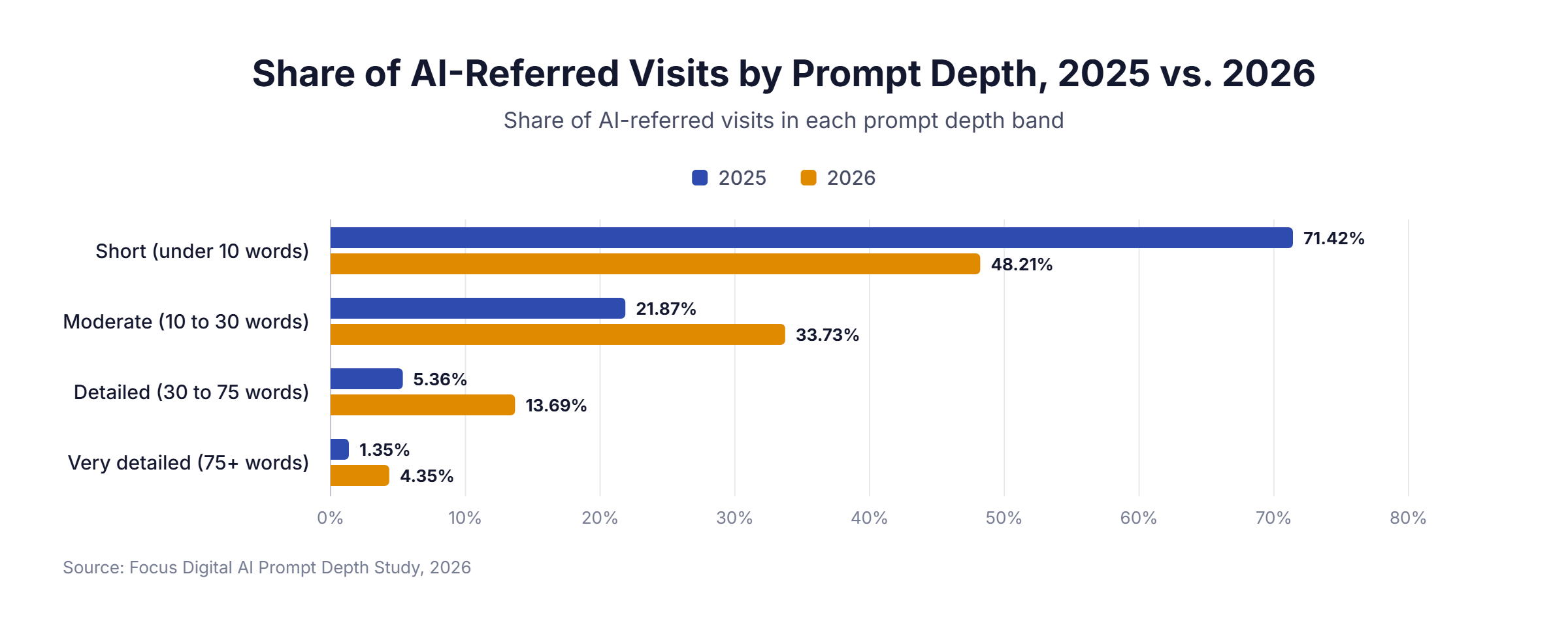
Buyers write longer, more detailed prompts every year. The table shows each prompt depth’s share of AI-referred visits in 2025 and 2026.
| Prompt depth | 2025 share of AI visits | 2026 share of AI visits | Change |
|---|---|---|---|
| Short (under 10 words) | 71.42% | 48.21% | -32.49% |
| Moderate (10 to 30 words) | 21.87% | 33.73% | +54.22% |
| Detailed (30 to 75 words) | 5.36% | 13.69% | +155.41% |
| Very detailed (75+ words) | 1.35% | 4.35% | +222.22% |
| Average words per prompt | 12.46 | 20.33 | +63.16% |
Key findings:
- Detailed prompts grew 2.69 times in share: Prompts of 30+ words grew from 6.71% to 18.05% of AI-referred visits. We think buyers learned that a longer prompt returns a better answer and started writing them on purpose.
- 75+ word prompts grew fastest: Their share rose +222.22%, from 1.35% to 4.35%. Buyers now paste in requirements lists, job descriptions, and project briefs.
Conversion Rate by Number of Prompts Before the Click
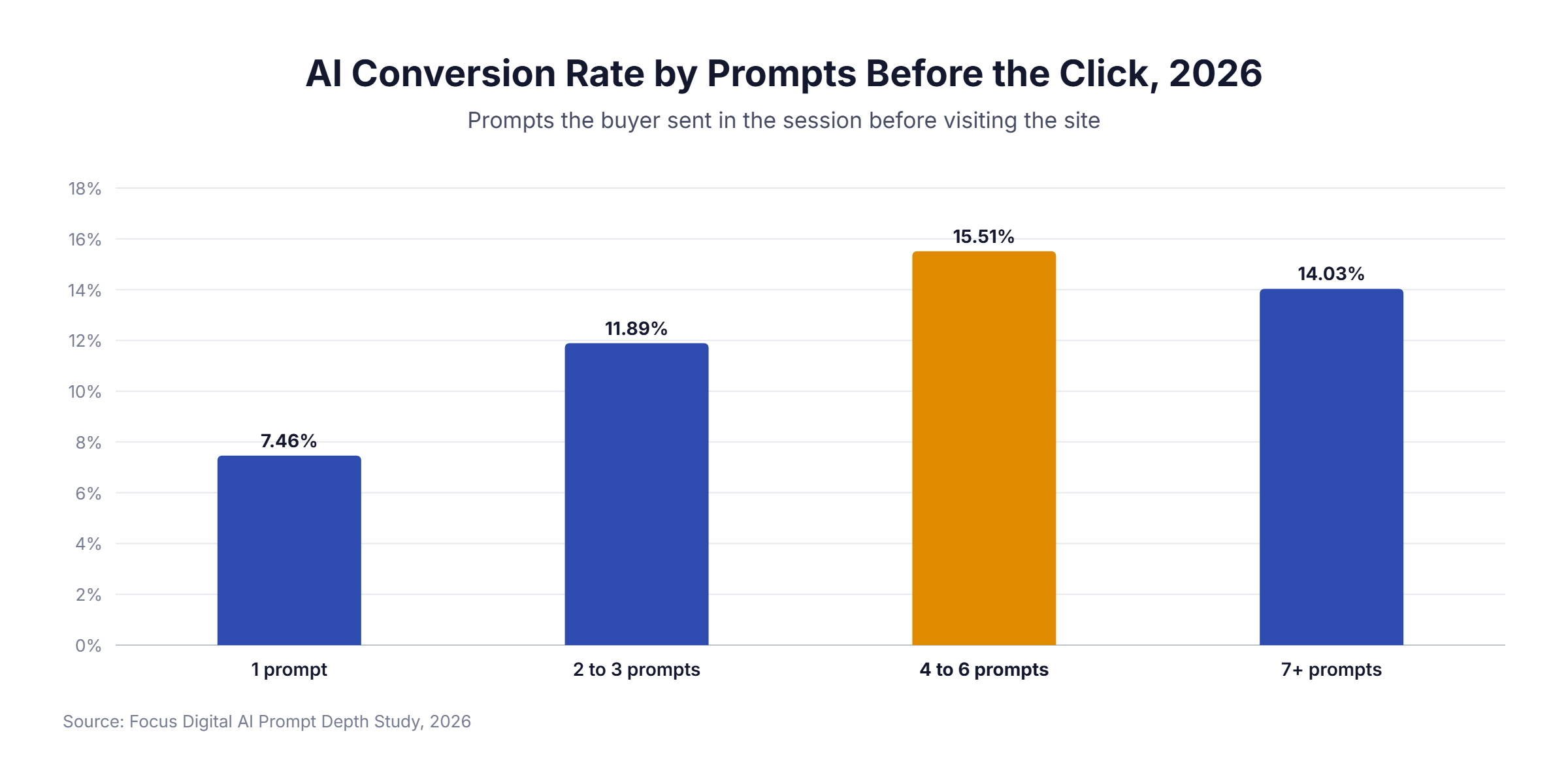
Prompt depth also builds across a conversation. The table shows conversion rate by how many prompts the buyer sent in the session before clicking through to a website.
| Prompts before the click | Share of AI visits | Conversion rate |
|---|---|---|
| 1 prompt | 61.47% | 7.46% |
| 2 to 3 prompts | 26.83% | 11.89% |
| 4 to 6 prompts | 8.92% | 15.51% |
| 7+ prompts | 2.78% | 14.03% |
Key findings:
- Conversion peaks at 4 to 6 prompts: Buyers who refine their question four to six times convert at 15.51%, 107.89% more than buyers who click after one prompt.
- Very long conversations convert less: At 7+ prompts, conversion drops 9.55% from the peak. AI models answer worse when details arrive in pieces: their success rate falls from about 90% on one fully specified prompt to about 65% when the same details come across several turns, and unreliability rises 112%.
- Front-load the details: A buyer gets the most tailored answer by giving the AI everything in the first prompt. Brands win those buyers by publishing the same specifics the buyer types.
Prompt Details That Raise AI Conversion Rate
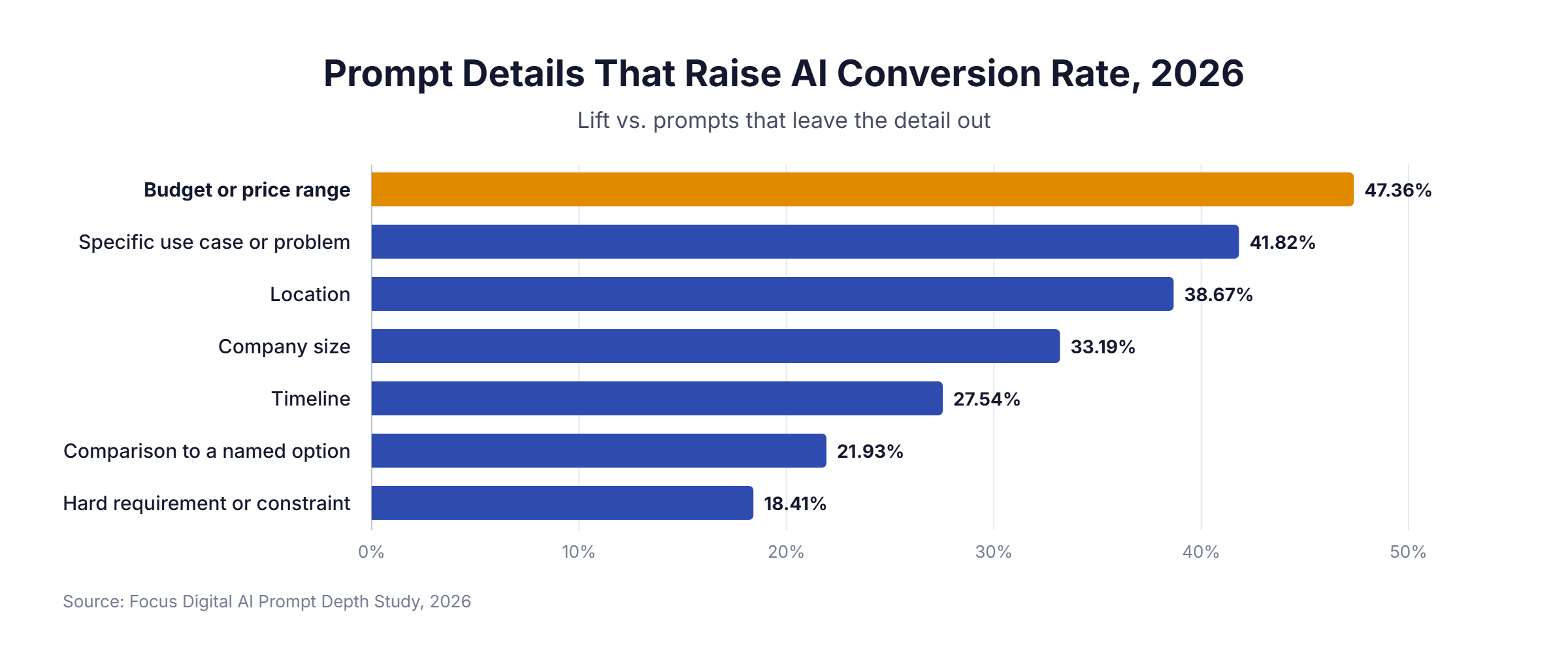
Some details in a prompt narrow the AI’s answer more than others. The table shows how much each detail raises conversion rate compared with prompts that leave it out.
| Detail in the prompt | Example | Raises conversion rate by |
|---|---|---|
| Budget or price range | “under $5,000 a month” | 47.36% |
| Specific use case or problem | “for a 40-bed assisted living facility” | 41.82% |
| Location | “in Charlotte, NC” | 38.67% |
| Company size | “for a 25-person accounting firm” | 33.19% |
| Timeline | “need it live by March” | 27.54% |
| Comparison to a named option | “vs. HubSpot” | 21.93% |
| Hard requirement or constraint | “must integrate with QuickBooks” | 18.41% |
Key findings:
- Budget is the strongest filter: A price range in the prompt raises conversion rate 47.36%. The AI drops options outside the budget, so the buyer reaches a company they can afford on the first call.
- Location and company size act as fit signals: Prompts that name a city (+38.67%) or a company size (+33.19%) send visits to companies that serve that exact market.
- Constraints help least on their own: A hard requirement adds 18.41%. Most companies never state what they integrate with, so the AI has little to match against.
AI Conversion Rate by Prompt Depth and Industry
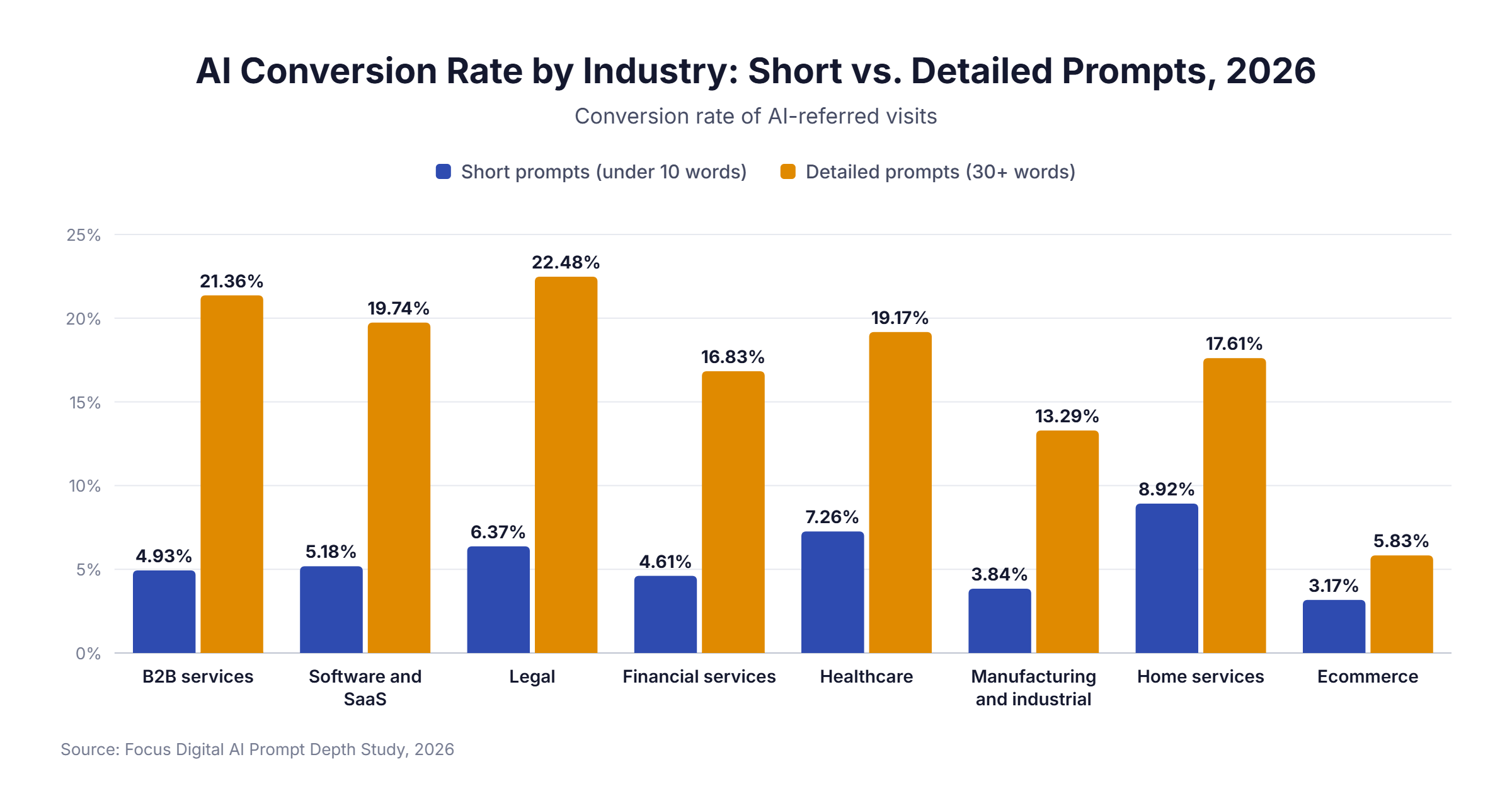
Considered purchases gain the most from detailed prompts. The table compares conversion rate for short prompts (under 10 words) and detailed prompts (30+ words) in each industry.
| Industry | Average words per prompt | Short prompts | Detailed prompts | Lift from detail |
|---|---|---|---|---|
| B2B services | 14.87 | 4.93% | 21.36% | +333.26% |
| Software and SaaS | 13.62 | 5.18% | 19.74% | +281.08% |
| Legal | 12.91 | 6.37% | 22.48% | +252.89% |
| Financial services | 12.14 | 4.61% | 16.83% | +265.07% |
| Healthcare | 11.38 | 7.26% | 19.17% | +164.04% |
| Manufacturing and industrial | 10.73 | 3.84% | 13.29% | +246.09% |
| Home services | 8.46 | 8.92% | 17.61% | +97.42% |
| Ecommerce | 6.19 | 3.17% | 5.83% | +83.91% |
Key findings:
- B2B buyers write the longest prompts and gain the most: B2B services prompts average 14.87 words, and detailed prompts convert 333.26% better than short ones.
- Ecommerce gains the least from detail: Ecommerce prompts average 6.19 words, and detailed prompts convert 5.83%. A shopper comparing products often clicks several stores, so detail in the prompt does less to settle the purchase.
- Legal and healthcare reward specifics: Detailed legal prompts convert at 22.48%, the highest of any industry. A prompt that names the case type and city returns two or three firms, and the buyer calls one of them.
AI Prompt Depth by AI Assistant
Each AI assistant draws a different kind of prompt. The table shows average words per prompt, the share of prompts with 30+ words, and conversion rate for each assistant.
| AI assistant | Average words per prompt | Share of prompts with 30+ words | Conversion rate |
|---|---|---|---|
| ChatGPT | 8.71 | 15.83% | 12.06% |
| Microsoft Copilot | 7.93 | 12.47% | 9.21% |
| Claude | 7.38 | 11.36% | 6.89% |
| Perplexity | 6.14 | 8.29% | 4.33% |
| Gemini | 4.86 | 5.74% | 2.48% |
Key findings:
- ChatGPT draws the most detailed prompts and converts best: ChatGPT visitors convert at 12.06%, and 15.83% of their prompts run 30+ words.
- Conversion rate follows prompt depth across assistants: Gemini prompts average 4.86 words and convert at 2.48%, the lowest of the five. Many Gemini visits start from a short query inside Google.
AI Prompt Length vs. Google Search Query Length
AI prompts carry far more context than search queries. The table compares average prompt length in 2025 and 2026.
| Search type | 2025 | 2026 | Change |
|---|---|---|---|
| Google search query | 3.52 | 3.62 | +2.84% |
| ChatGPT prompt that triggers a web search | 4.7 | 8.7 | +85.09% |
| ChatGPT prompt overall (no web search) | 24.9 | 13.5 | -45.79% |
| Prompts per ChatGPT session | 1.19 | 1.75 | +47.05% |
Key findings:
- AI prompts that lead to clicks nearly doubled in length: ChatGPT prompts that trigger a web search grew from 4.7 to 8.7 words, while Google queries held near 3.62 words.
- Buyers now refine in conversation: Prompts per ChatGPT session rose from 1.19 to 1.75. Buyers add details over several prompts before they click, building the same context a long first prompt provides.
Why Short AI Prompts Convert Poorly
The table lists the main reasons short prompts send weaker visits, with the conversion rate where each cause shows up.
| Cause | How it shows up | Conversion rate |
|---|---|---|
| The prompt gives the AI nothing to filter on | Under 10 words | 5.42% |
| The answer lists generic category leaders | 10 to 30 words | 10.87% |
| The buyer is still early in research | 1 prompt in the session | 7.46% |
| Brand pages lack budget, size, and location details | Detailed prompt, generic brand page | 9.63% |
| Fix: the brand publishes the details buyers type | Detailed prompt, specific brand page | 16.61% |
How to Win Detailed AI Prompts
Detailed prompts only help a brand whose pages answer the details. The table lists what to publish and how much each change raises conversion rate.
| Do this | What it fixes | Raises AI conversion rate by up to |
|---|---|---|
| Publish suitability pages by industry, company size, and use case | Detailed prompts that name a segment find no page that fits | 52.79% |
| Put price ranges and package minimums on service pages | Budget prompts get answered with competitors that publish prices | 47.36% |
| Add location pages with local proof points | Location prompts skip brands with no local page | 38.67% |
| Publish integration and requirement pages | Constraint prompts drop brands that never state what they support | 18.41% |
| Write comparison pages against named alternatives | “vs.” prompts pull competitor-written comparisons | 21.93% |
| Add timelines and onboarding steps to service pages | Timeline prompts favor brands that state launch times | 27.54% |
Key findings:
- Suitability pages match the prompt to the page: A buyer who writes “for a 25-person accounting firm” needs a page about that segment. A suitability page gives the AI an exact match to cite.
- Published prices win budget prompts: Most service businesses hide pricing, so the AI cites the few that publish their prices.
How These Figures Are Calculated
- Conversion rate: key events from AI-referred sessions ÷ AI-referred sessions × 100
- Prompt depth: words in the prompt or prompts that preceded the click, grouped into four bands
- Lift from a detail or change: (conversion rate with it ÷ conversion rate without it − 1) × 100
- Good ranges: below average is under 0.7 times the average, and good (top 25%) is 1.5 times the average or higher
Further Reading
To request the full dataset behind this study, contact Focus Digital.
About the Data
This study combines AI-referred sessions and conversions across Google Analytics 4 properties in service, B2B, and ecommerce industries with published research on AI prompt length, AI referral conversion rates, and multi-turn AI performance, covering 2025 and 2026.
Sources
(5)
- 1. Focus Digital AI Prompt Depth Study, 2026. A Focus Digital study of AI-referred sessions and conversions by assistant across Google Analytics 4 properties, combined with a compilation of the published prompt length, AI referral conversion, and conversation studies below.
- 2. Semrush, ChatGPT Search Insights (prompt length by search use, prompts per session)
- 3. Search Engine Land, ChatGPT vs. Non-Branded Organic Search Conversions (ChatGPT 1.81% vs. organic 1.39% across 94 ecommerce sites)
- 4. Ahrefs, Does AI Search Traffic Convert Better Than Traditional Search? (0.5% of visitors, 12.1% of signups)
- 5. Windows Central, Microsoft Research and Salesforce Study on Multi-Turn AI Conversations (single vs. multi-turn success rates)