
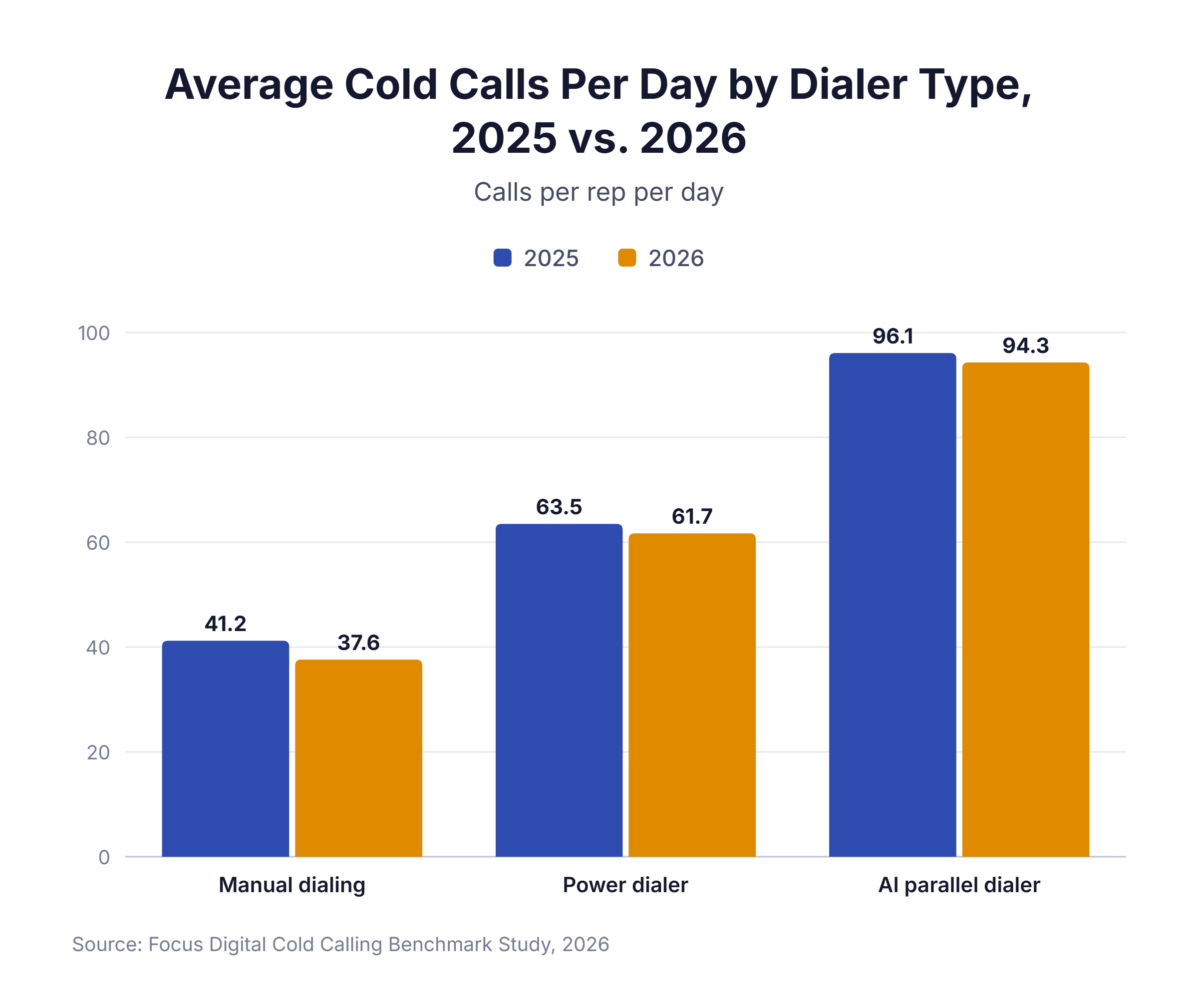
The average sales rep makes 54.4 cold calls per day in 2026, up from 52 in 2025. Reps on manual dialing average 37.6 calls per day, reps on power dialers average 61.7, and reps on AI parallel dialers average 94.3. Full-time outbound reps who spend most of the day on the phone average 69.5 calls.
We studied daily cold call volume by dialer type, industry, sales role, season, and time of day, along with how many dials it takes to book a meeting.
Key takeaways:
- The average rep makes 54.4 cold calls per day, 4.6% more than in 2025.
- Reps on AI parallel dialers make 2.5 times as many calls as manual dialers but book only 21% more meetings.
- Manual dialers book a meeting every 34.4 dials, compared with 71.4 dials on AI parallel dialers.
- 2.7% of cold calls book a meeting in 2026, up from 2.3% in 2025.
- Calls placed between 10:00 and 11:00 AM connect 22% of the time, 83.33% more often than calls placed from 8:00 to 9:00 AM.
- Teams making 40 to 60 calls per day convert 2.8% of calls, compared with 1.9% for teams making 80 or more.
In this report:
- Benchmarks: calls per day by dialer type, what a good daily call count is, and calls per day by industry and sales role
- Timing: dials per meeting, seasonal volume, and the best time to cold call
- How to fix it: why cold calls fail to book meetings and how to book more of them
Average Cold Calls Per Day by Dialer Type
Dialer type changes daily volume more than any other factor in our study. The table below shows daily calls, live conversations, and booked meetings for each setup.
| Dialer Type | Share of Reps | Calls Per Day, 2026 | Calls Per Day, 2025 | Change | Conversations Per Day | Meetings Booked Per Day |
|---|---|---|---|---|---|---|
| Manual dialing | 49.2% | 37.6 | 41.2 | -8.74% | 4.3 | 1.09 |
| Power dialer | 36.6% | 61.7 | 63.5 | -2.84% | 5.1 | 1.35 |
| AI parallel dialer | 14.2% | 94.3 | 96.1 | -1.88% | 4.9 | 1.32 |
Key research findings:
- The average rose because reps changed dialers. Reps on every dialer type made fewer calls than in 2025. The overall average still climbed 4.6% because the share of reps on manual dialing fell from 61.3% to 49.2%.
- More dials did not bring more meetings. AI parallel dialers produce 2.5 times the daily dials of manual dialing, and reps on them book only 21% more meetings per day.
- Power dialers book the most meetings. Power dialers raise volume while keeping one rep on each live call, which we believe explains their 1.35 meetings per day, the highest of the three setups.
We think the parallel dialer results reflect a tradeoff. The software dials several numbers at once and drops the extra pickups, so more prospects hang up before a rep says a word, and carriers flag the numbers as spam faster.
What Is a Good Number of Cold Calls Per Day?
A good daily call count depends on the role. Use these 2026 ranges to grade a rep against others in the same seat.
| Sales Role | Below Average | Average | Good (Top 25%) |
|---|---|---|---|
| Telemarketing Rep (B2C) | Under 89.9 | 128.7 | Above 160.8 |
| Inside Sales Rep (Full Cycle) | Under 47.5 | 67.9 | Above 84.8 |
| Outbound SDR (Appointment Setting) | Under 46.4 | 66.3 | Above 82.8 |
| Business Development Rep | Under 43.2 | 61.8 | Above 77.2 |
| Account Executive (Hybrid) | Under 22.1 | 31.6 | Above 39.5 |
| Field Sales Rep | Under 13.5 | 19.4 | Above 24.2 |
Key research findings:
- Grade reps on meetings first. A rep above the top 25% line on volume can still book fewer meetings than an average rep, because conversion falls from 2.8% to 1.9% once teams pass 80 calls per day.
- Volume targets fit SDRs best. Appointment setters spend the whole day prospecting, so a daily call target reflects their job. Account executives split the day with closing, and we think their targets should count booked meetings.
Average Cold Calls Per Day by Industry
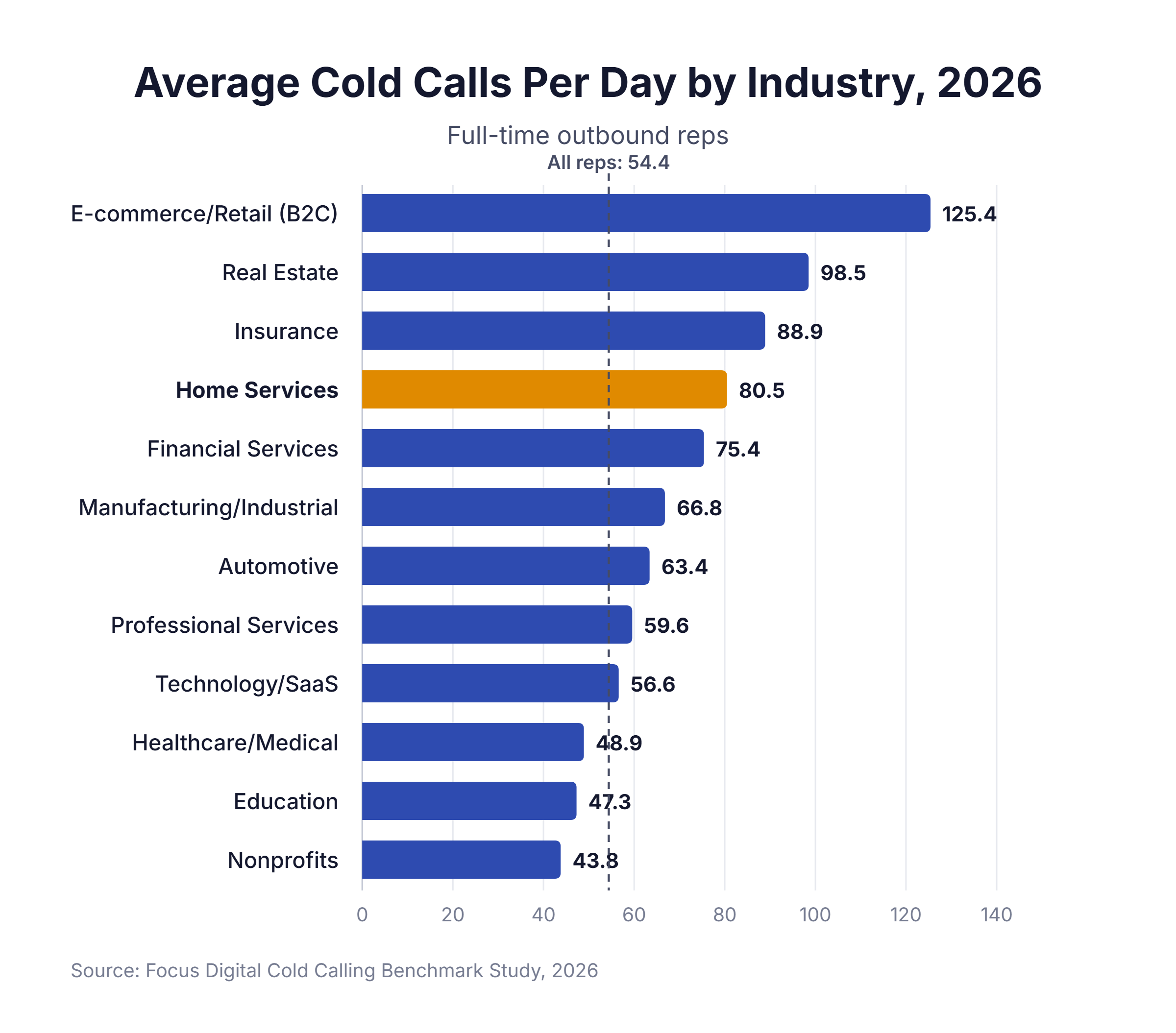
The table below breaks down daily cold call volume for full-time outbound reps across 12 industries. Calls per day equal calling hours multiplied by calls per hour, so each column shows where the volume comes from.
| Industry | Calls Per Day | Calling Hours Per Day | Calls Per Hour | Conversion Rate | Conversions Per Day | Change vs. 2025 |
|---|---|---|---|---|---|---|
| E-commerce/Retail (B2C) | 125.4 | 6.4 | 19.6 | 4.2% | 5.26 | +0.32% |
| Real Estate | 98.5 | 5.3 | 18.6 | 2.2% | 2.16 | +0.54% |
| Insurance | 88.9 | 5.7 | 15.6 | 2.1% | 1.86 | +4.53% |
| Home Services | 80.5 | 5.1 | 15.8 | 3.1% | 2.49 | +3.21% |
| Financial Services | 75.4 | 4.9 | 15.4 | 1.8% | 1.35 | +4.72% |
| Manufacturing/Industrial | 66.8 | 4.4 | 15.2 | 1.5% | 0.99 | +2.74% |
| Automotive | 63.4 | 4.6 | 13.8 | 1.9% | 1.19 | +2.23% |
| Professional Services | 59.6 | 4.2 | 14.2 | 2.4% | 1.43 | +2.71% |
| Technology/SaaS | 56.6 | 3.8 | 14.9 | 0.9% | 0.49 | +2.93% |
| Healthcare/Medical | 48.9 | 3.6 | 13.6 | 1.2% | 0.58 | +1.84% |
| Education | 47.3 | 3.7 | 12.8 | 2.3% | 1.08 | +5.13% |
| Nonprofits | 43.8 | 3.4 | 12.9 | 2.8% | 1.22 | +4.27% |
Key research findings:
- Calling hours explain most of the spread. E-commerce and retail reps make 2.5 times as many daily calls as healthcare reps, mostly because they spend 6.4 hours a day on the phone compared to 3.6.
- Home services gets the most from each day. Home services reps convert 2.49 calls per day, the most outside retail, by pairing above-average volume with a 3.1% conversion rate.
- Technology reps need the most calls per win. Technology and SaaS reps convert 0.49 calls per day, the lowest in the table, because longer sales cycles turn first calls into research conversations.
Average Cold Calls Per Day by Sales Role
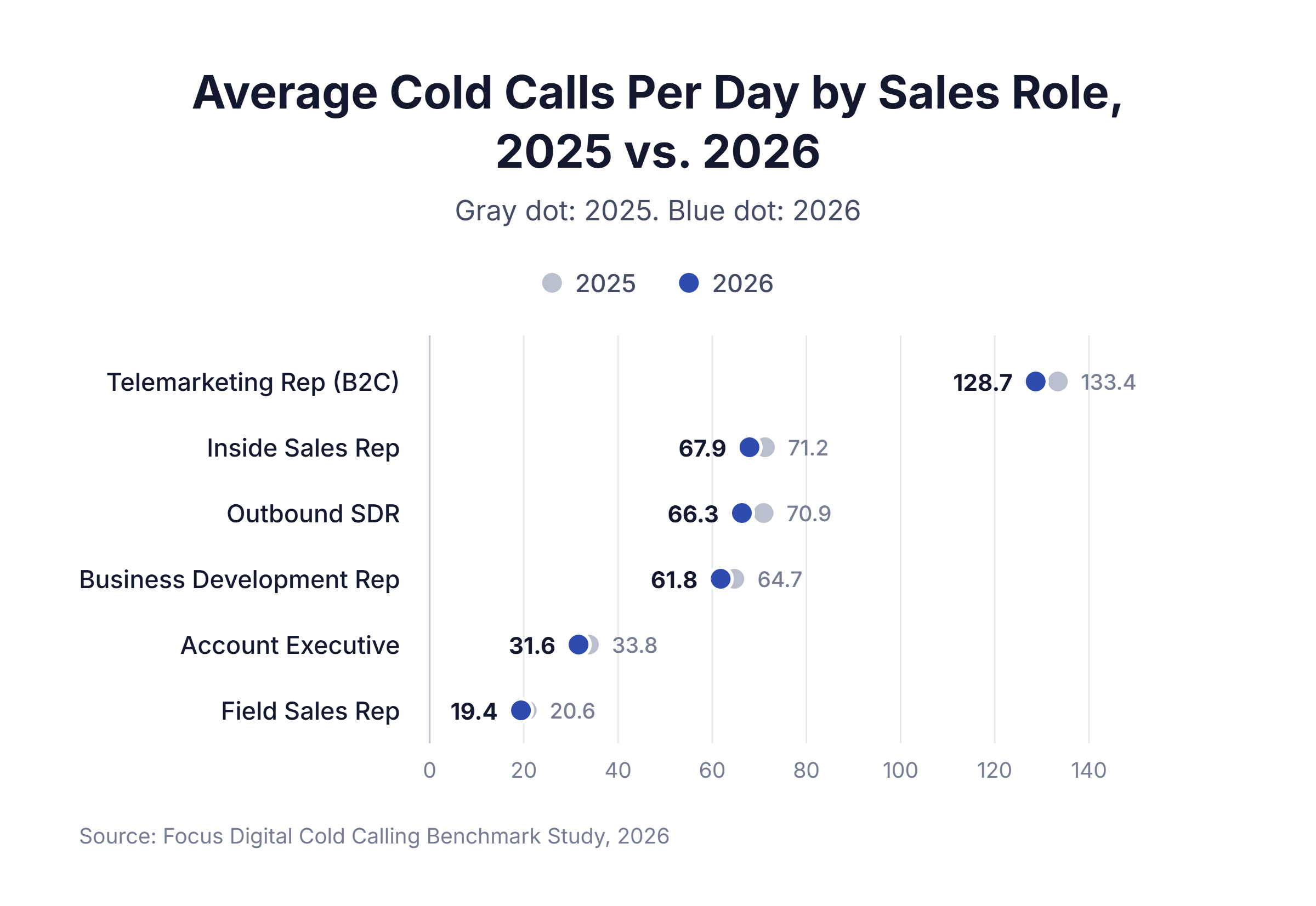
The table below shows how daily call volume changes with a rep’s role and how much of the day goes to prospecting.
| Sales Role | Calls Per Day, 2026 | Calls Per Day, 2025 | Change | Primary Focus |
|---|---|---|---|---|
| Telemarketing Rep (B2C) | 128.7 | 133.4 | -3.53% | High-volume consumer outreach |
| Inside Sales Rep (Full Cycle) | 67.9 | 71.2 | -4.64% | End-to-end sales process |
| Outbound SDR (Appointment Setting) | 66.3 | 70.9 | -6.49% | Lead qualification and meeting booking |
| Business Development Rep | 61.8 | 64.7 | -4.49% | Pipeline generation and qualification |
| Account Executive (Hybrid) | 31.6 | 33.8 | -6.51% | Prospecting and deal closing |
| Field Sales Rep | 19.4 | 20.6 | -5.83% | Relationship building and complex sales |
Key research findings:
- Every role made fewer calls per rep. Daily volume fell 3.53% to 6.51% across all six roles. We believe reps now spend more of the day researching accounts with AI tools before they dial.
- Prospecting time sets the ceiling. Sales development reps (SDRs) who only set appointments make more than twice as many calls as account executives, who split the day between prospecting and closing.
- B2C reps dial almost twice as often. B2C telemarketing reps make 96% more calls than the average B2B outbound rep.
How Many Cold Calls It Takes to Book a Meeting
Calls book meetings only when they reach a live conversation. The table below shows the outcome of 100 cold calls for each dialer setup.
| Dialer Type | Live Conversations | Meetings Booked | Dials Per Meeting |
|---|---|---|---|
| Manual dialing | 11.7 | 2.9 | 34.4 |
| Power dialer | 8.3 | 2.2 | 45.4 |
| AI parallel dialer | 5.3 | 1.4 | 71.4 |
Key research findings:
- Conversations are getting harder to reach. The average rep holds 4.4 quality conversations per day, a figure that has fallen 45% since 2014.
- Conversion rose even as volume per rep fell. About 2.7% of cold calls book a meeting in 2026, up from 2.3% in 2025, which supports our read that reps now research more before they dial.
- Persistence pays off by the third attempt. Three call attempts reach 93% of the conversations a rep will ever have with a prospect, and five attempts reach 98.6%.
Cold Call Volume by Season
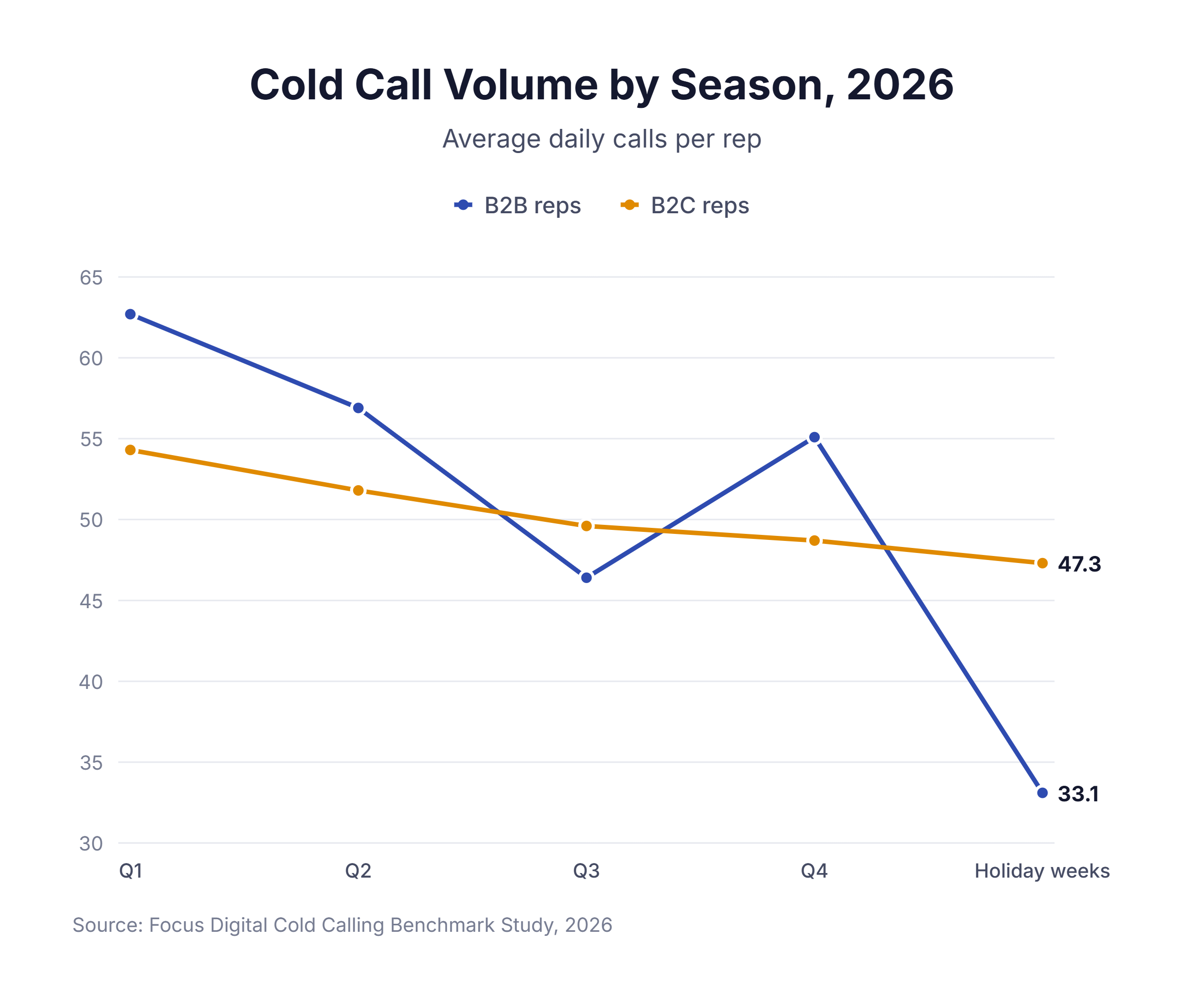
Call volume follows budget cycles and prospect availability. The table below shows average daily calls per rep for each quarter and for the holiday weeks.
| Time Period | Average Daily Volume, 2026 | Average Daily Volume, 2025 | B2B Volume | B2C Volume |
|---|---|---|---|---|
| Q1 (Jan to Mar) | 60.9 | 58.2 | 62.7 | 54.3 |
| Q2 (Apr to Jun) | 55.8 | 53.3 | 56.9 | 51.8 |
| Q3 (Jul to Sep) | 47.1 | 45.1 | 46.4 | 49.6 |
| Q4 (Oct to Dec) | 53.8 | 51.4 | 55.1 | 48.7 |
| Holiday Weeks (Thanksgiving to New Year’s) | 38.6 | 36.9 | 33.1 | 47.3 |
Key research findings:
- New budgets drive the first-quarter peak. Q1 shows 29% higher call volume than summer months as teams act on new annual plans and budgets.
- B2B teams front-load the fourth quarter. B2B reps make 68.9 calls per day from October to mid-November, then drop to 33.1 during the holiday weeks.
- B2C reps hold steady all year. B2C volume varies far less across the year, and B2C reps out-dial B2B reps during the summer and the holidays.
Best Time to Cold Call
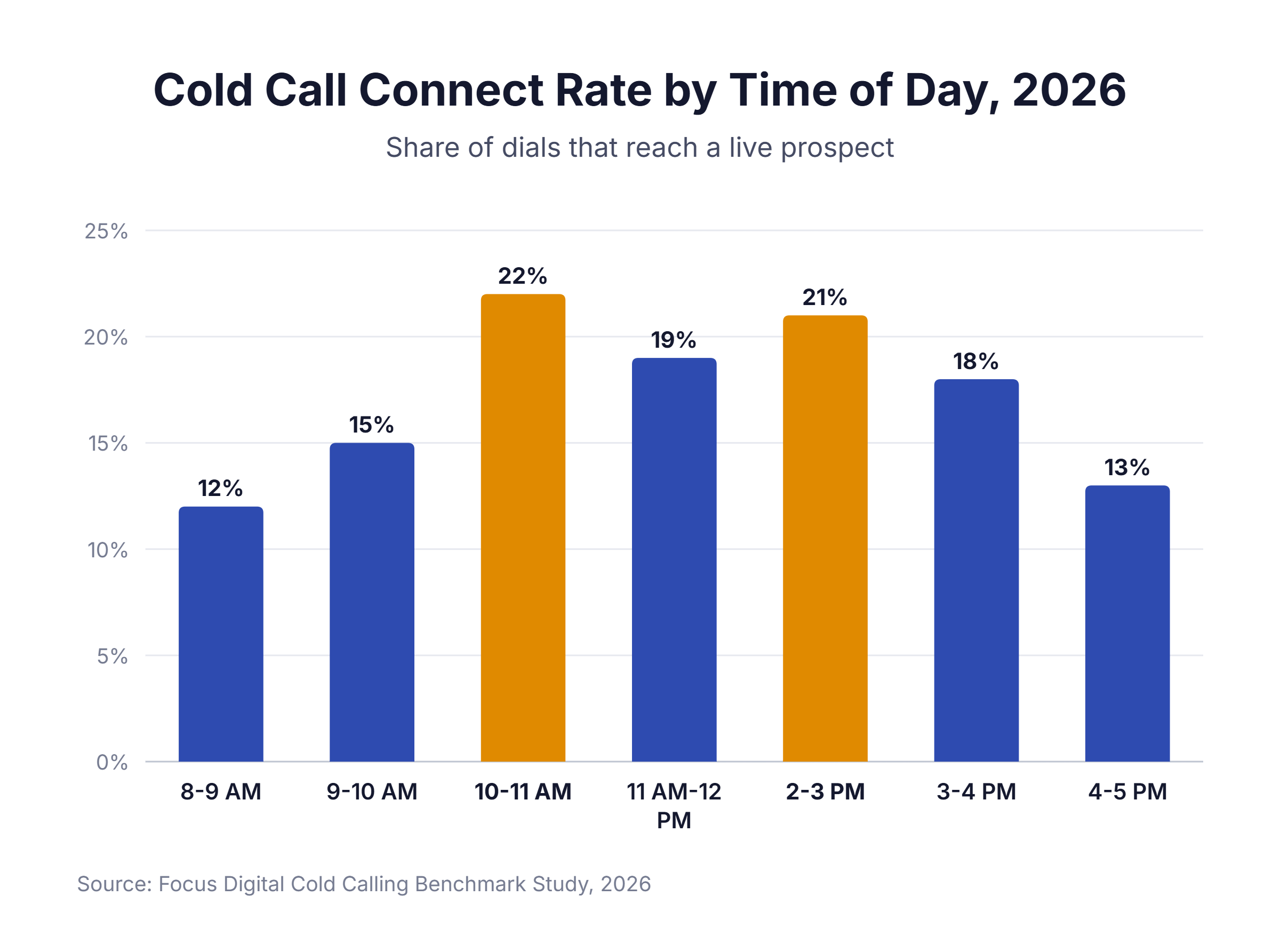
Our research identified the calling windows with the highest connect rates and the best days to call.
| Time Window | Calls Per Hour | Connect Rate, 2026 | Connect Rate, 2025 | Best Days |
|---|---|---|---|---|
| 8:00 to 9:00 AM | 6.8 | 12% | 13% | Tuesday to Thursday |
| 9:00 to 10:00 AM | 7.5 | 15% | 16% | Tuesday to Thursday |
| 10:00 to 11:00 AM | 8.9 | 22% | 23% | Tuesday to Wednesday |
| 11:00 AM to 12:00 PM | 8.2 | 19% | 20% | Tuesday to Wednesday |
| 2:00 to 3:00 PM | 8.7 | 21% | 22% | Tuesday to Thursday |
| 3:00 to 4:00 PM | 7.9 | 18% | 19% | Tuesday to Wednesday |
| 4:00 to 5:00 PM | 6.1 | 13% | 14% | Monday to Thursday |
Key research findings:
- Late morning and mid-afternoon win. The 10:00 to 11:00 AM window reaches a 22% connect rate, and the 2:00 to 3:00 PM window follows at 21%, after prospects clear their morning meetings.
- Connect rates slipped a point in every window. We believe spam labeling on carrier networks explains most of the drop, since parallel dialers burn through numbers faster.
- Peak blocks raise the whole day. Teams scheduling call blocks during peak windows achieve 40% higher daily productivity than those calling throughout the day.
Cold Call Volume vs. Conversion Rate
Our analysis shows how daily call volume relates to conversion, which helps managers set realistic call quotas.
| Daily Call Volume | Conversion Rate | Typical Approach |
|---|---|---|
| 20 to 30 calls | 4.1% | Well-researched calls in complex B2B sales |
| 40 to 60 calls | 2.8% | Balanced volume and personalization |
| 80 or more calls | 1.9% | High volume with little personalization |
Key research findings:
- Quotas above 80 calls cost conversion. High-volume teams convert 0.9 points less than teams making 40 to 60 calls, because reps have less time to personalize.
- Admin time limits volume more than effort. The average connected cold call lasts 93 seconds, so most of a rep’s day goes to dialing, waiting, and logging calls. CRM integration cuts administrative time by 35%.
Cold Calls Per Day: 2025 vs. 2026
The table below compares our full study across the two years.
| Metric | 2025 | 2026 | Change |
|---|---|---|---|
| Average cold calls per day (all reps) | 52 | 54.4 | +4.6% |
| Reps using AI parallel dialers | 6.7% | 14.2% | +7.5 points |
| Reps dialing manually | 61.3% | 49.2% | -12.1 points |
| Share of cold calls that book a meeting | 2.3% | 2.7% | +0.4 points |
Why Cold Calls Fail to Book Meetings
Most weak cold calling results trace back to a setup choice the team controls. Each cause below shows the result it produces next to the stronger alternative.
| Cause | Result With the Cause | Result After the Fix |
|---|---|---|
| Calling early in the morning | 12% connect rate (8:00 to 9:00 AM) | 22% connect rate (10:00 to 11:00 AM) |
| Quotas above 80 calls per day | 1.9% conversion | 2.8% conversion (40 to 60 calls) |
| Parallel dialing for meetings | 71.4 dials per meeting | 34.4 dials per meeting (manual dialing) |
| Manual dialing for volume | 1.09 meetings per day | 1.35 meetings per day (power dialer) |
| Logging calls by hand | 35% of the day on admin work | 15 to 20 more calls per day (CRM integration) |
| Stopping after three attempts | 93% of reachable conversations | 98.6% of conversations (five attempts) |
Key research findings:
- Timing is the cheapest fix. Moving call blocks to late morning costs nothing and nearly doubles the connect rate.
- The right dialer depends on the goal. Power dialers book the most meetings per day, and manual dialing books the most meetings per dial, so each team should weigh meetings per day against the cost of every extra dial.
How to Book More Meetings From Cold Calls
Each change below improves the result shown by up to the amount listed, measured from the result before the change.
| Do This | What It Fixes | What Improves | By Up To |
|---|---|---|---|
| Switch meeting-focused reps from parallel to manual or power dialing | Prospects hanging up on dropped calls | Meetings per dial | 107.55% |
| Move call blocks to 10:00 to 11:00 AM | Prospects in early meetings | Connect rate | 83.33% |
| Cap quotas at 40 to 60 researched calls | Generic pitches at high volume | Conversion rate | 47.36% |
| Block peak calling windows on the calendar | Calls scattered across the day | Daily productivity | 40% |
| Connect the dialer to the CRM | Manual call logging | Calls per day | 36.76% |
| Move manual dialers to a power dialer | Time lost between calls | Meetings per day | 23.85% |
The gains overlap, so they do not add together. We think managers should track meetings booked per rep each week and treat calls per day as a leading indicator.
Frequently Asked Questions
Is 100 cold calls a day realistic? Yes, with a dialer. Full-time outbound reps average 15.4 calls per hour, so 100 calls take about 6.4 hours of calling. Reps on AI parallel dialers average 94.3 calls per day, so 100 calls fit in a normal workday.
How long does it take to make 100 cold calls? About 6.4 hours at the average outbound pace of 15.4 calls per hour.
What percentage of cold calls work? About 2.7% of cold calls book a meeting in 2026. Manual dialers in our study book 2.9 meetings per 100 dials.
What is the best time of day to cold call? 10:00 to 11:00 AM on Tuesday or Wednesday, when connect rates reach 22%.
How long is a cold call? The average connected cold call lasts 93 seconds.
How These Figures Are Calculated
- Calls per day = calling hours per day × calls per hour
- Conversions per day = calls per day × conversion rate
- Dials per meeting = 100 ÷ meetings booked per 100 calls
- Good (top 25%) and below average ranges = 1.25 times and 0.7 times each role’s average daily calls
- 2025 figures by dialer type, sales role, season, and time window = Focus Digital modeling, calibrated so the 2025 dialer mix (61.3% manual, 32% power, 6.7% AI parallel) reproduces the published 2025 average of 52 calls per day
- Improvement from a change = (result after the change ÷ result before the change − 1) × 100, using the paired figures in the tables above; the CRM figure is 20 added calls ÷ 54.4 average calls
Further Reading and Next Steps
If you are building an outbound sales strategy, you are likely also weighing email outreach and other channels. See our Average Cold Call Conversion Rate by Industry and Average Cold Call Connect Rate by Industry and Time of Day reports.
If you would like help with your outbound sales strategy, we build lead generation systems that produce qualified prospects every month. Please reach out here with any questions.
Sources
(6)
- Focus Digital Cold Calling Benchmark Study, 2026. A compilation of the published benchmarks from Cognism, Saleshandy, the Bridge Group, HubSpot, and Gradient Works (sources 2 to 6), combined with Focus Digital modeling. The modeling produces the 2025 figures by dialer type, sales role, season, and time window, the conversions per day column, and the good and below average ranges, using the methods in “How These Figures Are Calculated”.
- Cognism, 2025 Cold Calling Report
- Saleshandy, Cold Calling Statistics for Outbound Sales in 2026
- Bridge Group, SDR Metrics and Compensation Report (via UpLead)
- HubSpot, State of Cold Calling
- Gradient Works, SDR Performance Benchmarks