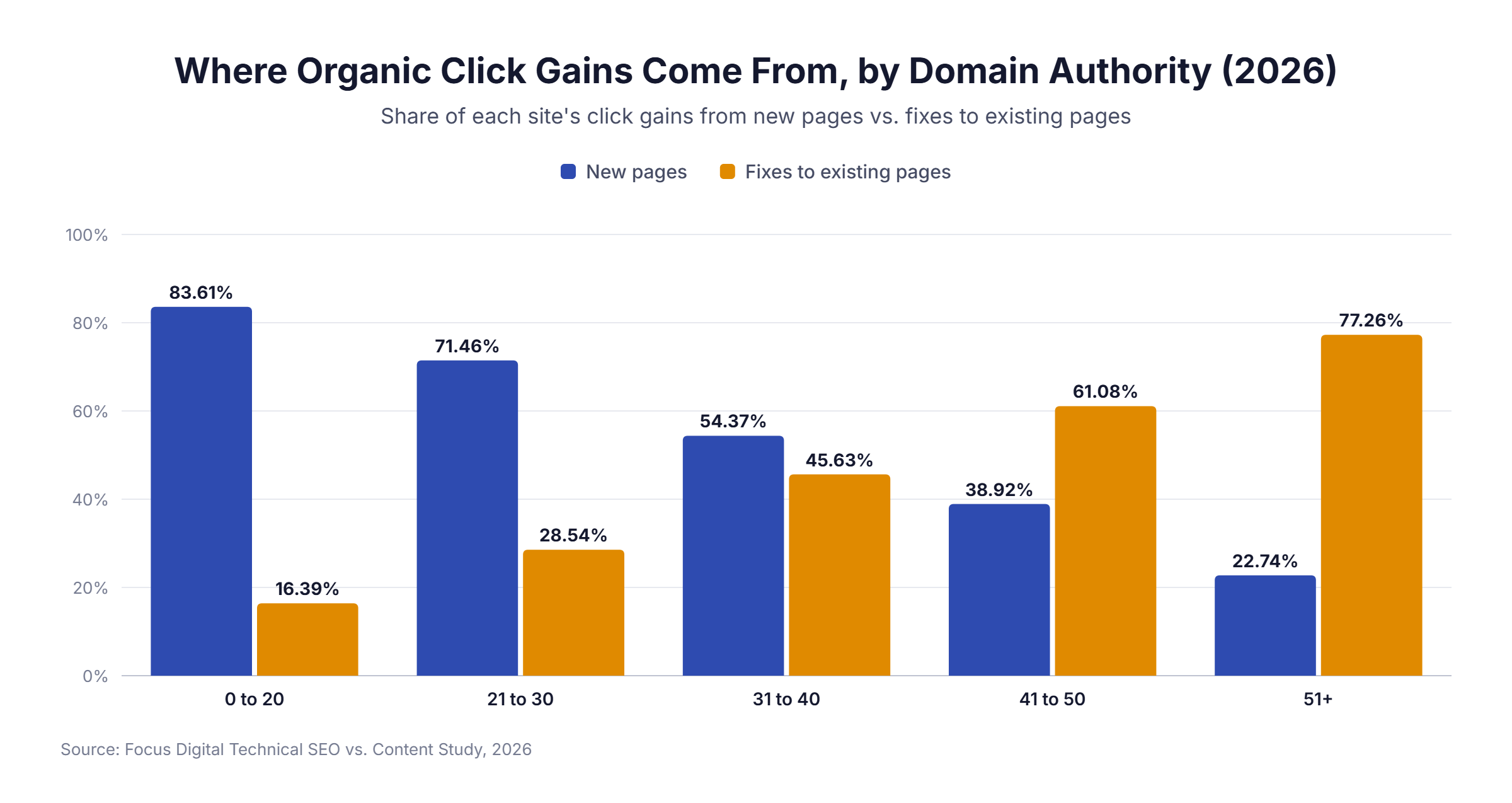
Technical SEO pays off in proportion to a site’s authority and the number of pages it already ranks. Sites with a domain authority score of 51 or higher get 77.26% of their organic click gains from technical and on-page fixes to existing pages, while sites scoring 0 to 20 get 83.61% of theirs from new pages. A title or H1 rewrite lifts clicks 6.86 times more on a high-authority site than on a low-authority one.
The reason is page inventory. A small, low-trust site has only a handful of pages that rank, so a technical fix has almost nothing to work on. A high-authority site has hundreds of ranking pages, and small changes to them produce large swings in traffic.
We studied where organic growth comes from at each level of domain authority, by page inventory, change type, and time to impact. We measure site authority with Ahrefs’ Domain Rating (DR), a 0 to 100 score based on how many websites link to a domain and how strong those linking sites are. The scale is logarithmic, so each step up is harder to reach than the last.
Key Takeaways
- New pages drive 83.61% of organic click gains on low-authority sites (0 to 20).
- Technical and on-page fixes drive 77.26% of click gains on high-authority sites (51+).
- A title or H1 rewrite lifts clicks 21.83% on high-authority sites, 6.86 times the 3.18% lift on low-authority sites.
- 96.55% of pages get no Google traffic, so a fix only pays off on pages that already rank.
- Fixes to existing pages earned a larger share of click gains in 2026 than in 2025 at every authority level.
- On high-authority sites, a title rewrite shows a measurable lift in 1.9 weeks, against 6.4 weeks for a new page.
Contents:
- Benchmarks: where click gains come from by domain authority, page inventory, and what a good lift from a rewrite looks like
- Breakdowns: change type, time to impact, and the 2025 to 2026 trend
- How to fix it: why technical fixes do little on low-authority sites, and what to prioritize at each level
Technical SEO vs. Content: Where Click Gains Come From by Domain Authority
The table below splits each site’s organic click gains between new pages and fixes to pages that already existed, grouped by domain authority score. It adds the payoff of one new page and one title or H1 rewrite at each level.
| Domain authority | Gains from new pages | Gains from fixes to existing pages | Monthly clicks per new page (month six) | Click lift per title or H1 rewrite |
|---|---|---|---|---|
| 0 to 20 | 83.61% | 16.39% | 11.27 | +3.18% |
| 21 to 30 | 71.46% | 28.54% | 19.83 | +5.92% |
| 31 to 40 | 54.37% | 45.63% | 31.46 | +9.71% |
| 41 to 50 | 38.92% | 61.08% | 47.29 | +14.36% |
| 51+ | 22.74% | 77.26% | 68.91 | +21.83% |
Key findings
- The crossover sits between 31 and 50: Sites scoring 31 to 40 still get a slight majority of gains from new pages. By 41 to 50, fixes to existing pages take over at 61.08%. We think 40 is the score where a site has enough pages ranking on page two that small changes start pushing them onto page one.
- New pages pay more on strong sites too: A new page on a 51+ site earns 68.91 clicks a month by month six, 6.11 times what the same page earns on a 0 to 20 site. Authority raises the payoff of every action, so the question at each level is which action returns the most per hour of work.
- Low-authority sites grow fastest when they publish: The median site scoring 0 to 20 grew nonbranded clicks 199.42% year over year, with most of that growth coming from new pages.
Our read on this is a bell curve of site authority. A low-trust site with five pages has nothing technical to rank, because none of those pages rank where a better title would reach a searcher. Tons of content production is the fastest way to grow at that end. As a site climbs the curve, its existing pages already rank near the top of page one or two, and small technical changes start producing big differences.
Small wording changes show the effect clearly on strong sites. When a high-authority ecommerce category page switches its H1 and title to the singular form of its main keyword, weekly impressions for that term can climb from about 500 to roughly 4,000 within a few weeks, with no other change to the page.
Page Inventory by Domain Authority: Why Fixes Need Pages to Work
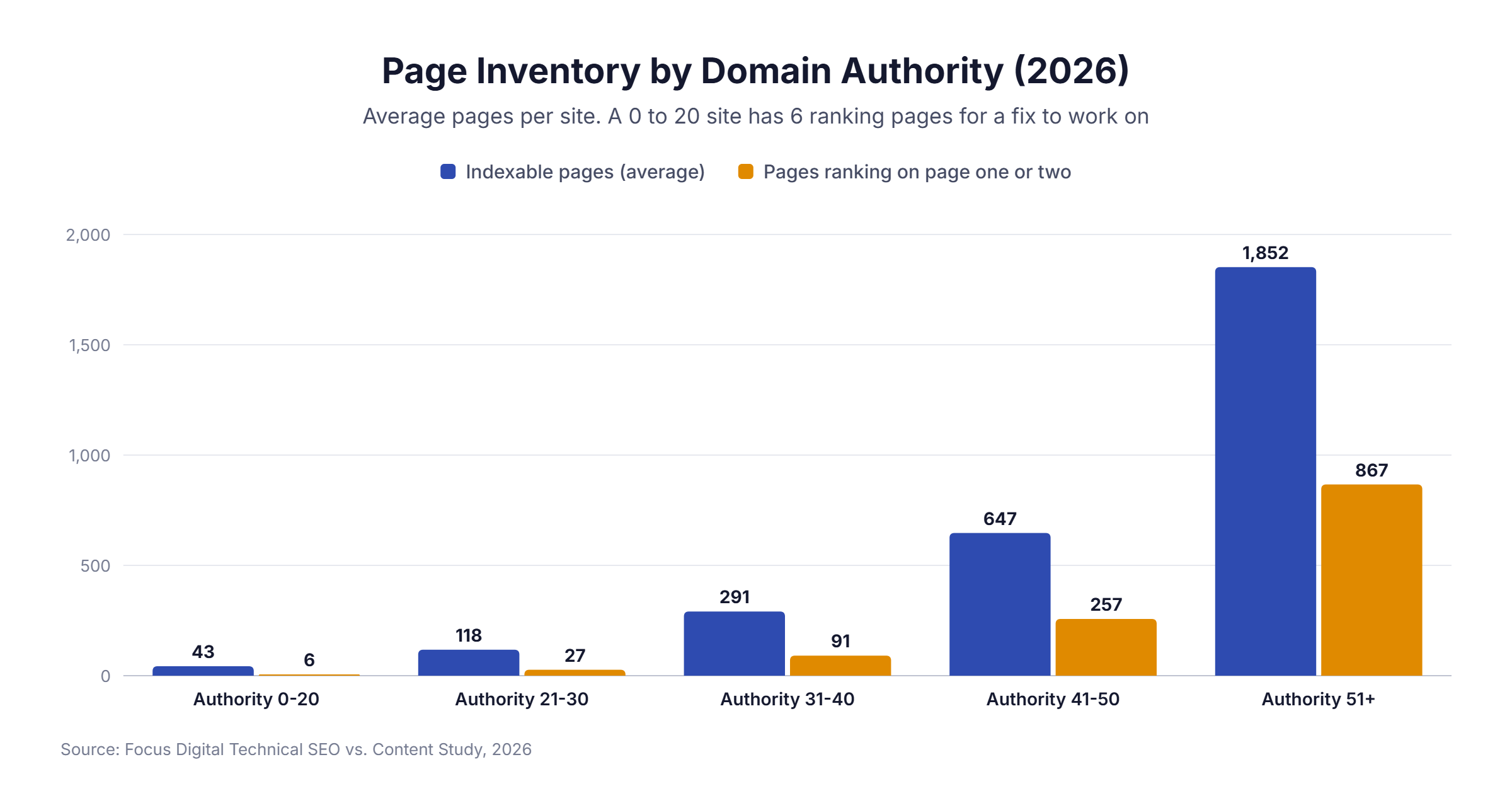
A technical or on-page fix can only lift a page that already ranks. The table below shows how many pages the average site has at each authority level, and how many of them rank where a fix can move them.
| Domain authority | Indexable pages (average) | Pages with any impressions | Pages ranking on page one or two | Pages a fix can lift |
|---|---|---|---|---|
| 0 to 20 | 43 | 38.64% | 14.37% | 6 |
| 21 to 30 | 118 | 52.17% | 22.91% | 27 |
| 31 to 40 | 291 | 63.82% | 31.58% | 91 |
| 41 to 50 | 647 | 72.46% | 39.74% | 257 |
| 51+ | 1,852 | 81.29% | 46.82% | 867 |
Key findings:
- Most pages on the web get no search traffic: 96.55% of pages get zero visits from Google, and pages with no linking websites almost never break 1,000 monthly visits (about 1 in 6,671). A fix on a page in that group has no traffic to multiply.
- Google itself says crawl work is for big sites: Google’s crawl budget guide is written for sites with 1 million or more pages, or 10,000 or more pages that change daily. A small site gets crawled in full without any technical work.
- The fix count compounds with authority: Each step up the curve roughly doubles to triples the number of pages a title rewrite can reach. At 51+, one template change on category or service pages can touch hundreds of ranking URLs at once.
What Is a Good Click Lift From a Title or H1 Rewrite?
A good lift from a single title or H1 rewrite depends on the site’s authority. The table below shows the ranges for below-average, average, and good (top 25%) results.
| Domain authority | Below average | Average | Good (top 25%) |
|---|---|---|---|
| 0 to 20 | Under 1.89% | 3.18% | 4.77% or higher |
| 21 to 30 | Under 3.55% | 5.92% | 8.88% or higher |
| 31 to 40 | Under 5.82% | 9.71% | 14.56% or higher |
| 41 to 50 | Under 8.61% | 14.36% | 21.54% or higher |
| 51+ | Under 13.09% | 21.83% | 32.74% or higher |
Key findings:
- A good result on a weak site is an average result on a mid-level one: A top-25% rewrite on a 0 to 20 site (4.77%) falls below the average for sites scoring 21 to 30 (5.92%). Judge a rewrite against sites at the same authority level.
- Google rewrites most titles anyway: Google rewrites 61.6% of title tags in search results, and titles of 51 to 60 characters get rewritten least, at 39% to 42%. A rewrite only pays when Google shows the version you wrote, so keep titles in that range.
- Strong sites can measure the lift: Controlled SEO split tests run on large sites with hundreds of template pages, because a small site doesn’t have enough pages to split into test and control groups. Most of those tests come back negative or flat, so the winners are worth finding only where one change reaches hundreds of pages.
Click Lift by Change Type and Domain Authority
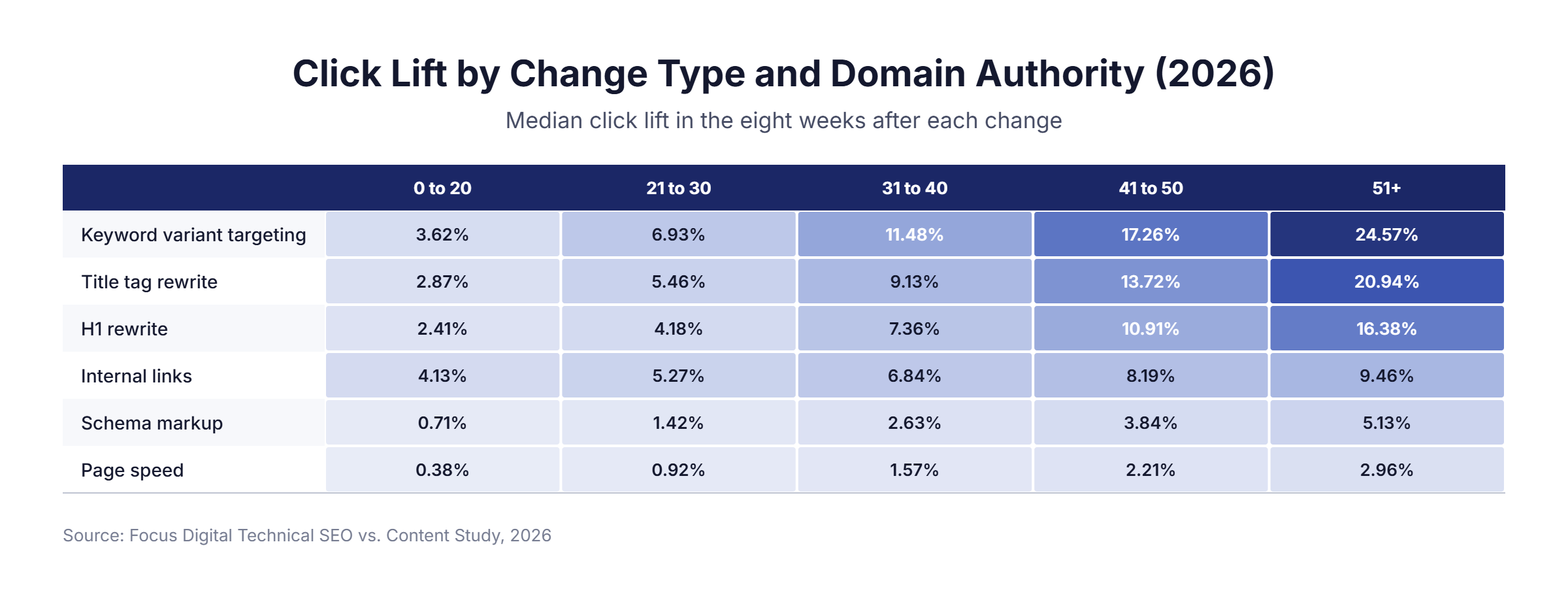
The table below shows the median click lift for six common changes at each authority level, measured over the eight weeks after the change went live.
| Change | 0 to 20 | 21 to 30 | 31 to 40 | 41 to 50 | 51+ |
|---|---|---|---|---|---|
| Keyword variant targeting | +3.62% | +6.93% | +11.48% | +17.26% | +24.57% |
| Title tag rewrite | +2.87% | +5.46% | +9.13% | +13.72% | +20.94% |
| H1 rewrite | +2.41% | +4.18% | +7.36% | +10.91% | +16.38% |
| Internal links | +4.13% | +5.27% | +6.84% | +8.19% | +9.46% |
| Schema markup | +0.71% | +1.42% | +2.63% | +3.84% | +5.13% |
| Page speed | +0.38% | +0.92% | +1.57% | +2.21% | +2.96% |
Key findings:
- Internal links are the best fix on a low-authority site: At 0 to 20, internal links lift clicks 4.13%, more than any other change. We believe new links help Google find and rank pages that a young site’s thin link profile leaves buried.
- Searchers’ exact wording beats the “correct” spelling: Keyword variant targeting covers changes like singular vs. plural, or a brand spelled without hyphens and accent marks. Google treats those versions as separate searches with separate results. A page that matches the version people type wins clicks that the correct spelling misses.
- Every technical lever scales with authority: Schema markup lifts clicks 0.71% on a 0 to 20 site and 5.13% on a 51+ site, and page speed goes from 0.38% to 2.96%. A fix multiplies traffic a page already has, so the payoff grows with the page count and rankings behind it.
How Technical SEO vs. Content Changed From 2025 to 2026
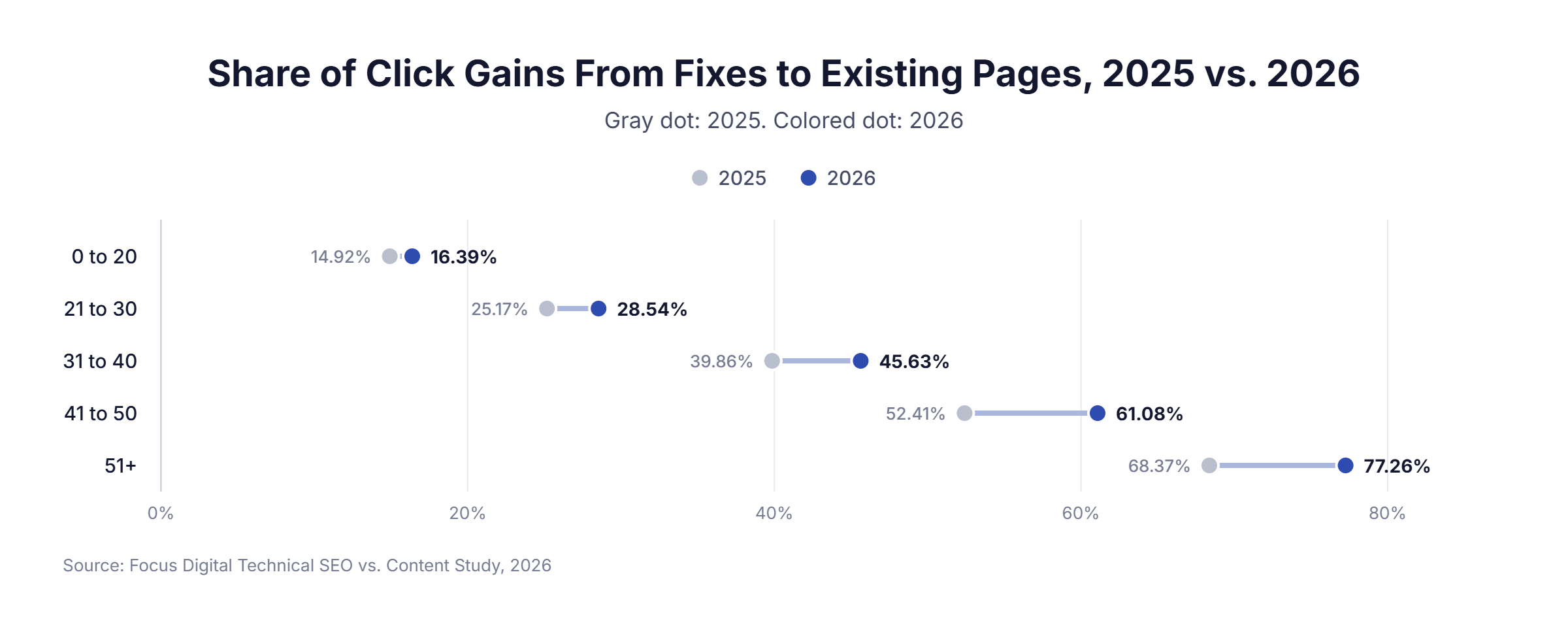
Fixes to existing pages earned a larger share of click gains in 2026 at every authority level.
| Domain authority | Gains from fixes, 2025 | Gains from fixes, 2026 | Change (points) |
|---|---|---|---|
| 0 to 20 | 14.92% | 16.39% | +1.47 |
| 21 to 30 | 25.17% | 28.54% | +3.37 |
| 31 to 40 | 39.86% | 45.63% | +5.77 |
| 41 to 50 | 52.41% | 61.08% | +8.67 |
| 51+ | 68.37% | 77.26% | +8.89 |
Key findings:
- The shift grew with authority: Sites scoring 0 to 20 moved 1.47 points toward fixes, while 51+ sites moved 8.89 points. We think strong sites added pages in 2025 that now rank on page one or two, which gave their 2026 fixes more pages to reach.
- Low-authority sites still need content first: Even after the shift, sites scoring 0 to 20 get more than five times as much growth from new pages as from fixes.
How Long Technical SEO and Content Changes Take to Work
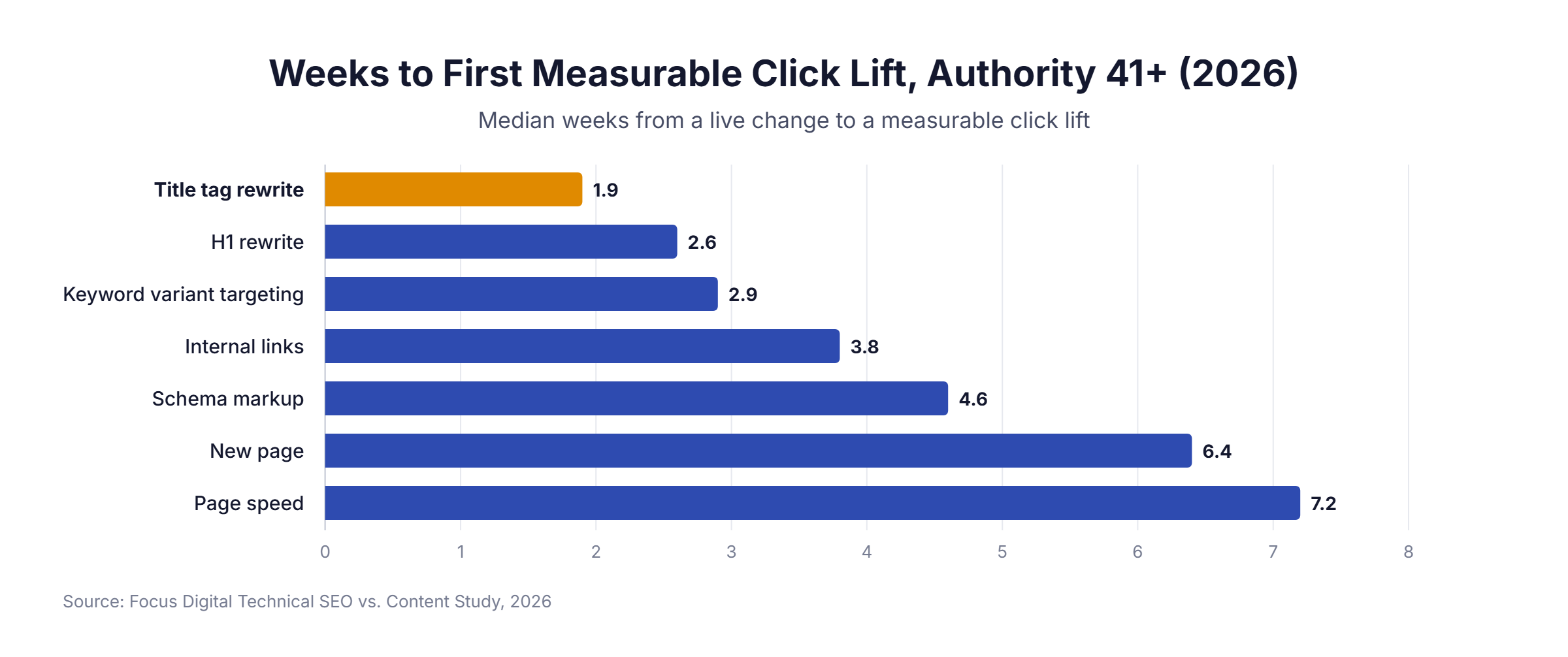
Time to impact shrinks as authority grows, because Google crawls strong sites more often. The table shows median weeks from a live change to a measurable click lift.
| Change | Authority 0 to 30 | Authority 41+ |
|---|---|---|
| Title tag rewrite | 4.3 weeks | 1.9 weeks |
| H1 rewrite | 5.1 weeks | 2.6 weeks |
| Keyword variant targeting | 5.7 weeks | 2.9 weeks |
| Internal links | 6.4 weeks | 3.8 weeks |
| Schema markup | 7.9 weeks | 4.6 weeks |
| New page | 16.6 weeks | 6.4 weeks |
| Page speed | 11.3 weeks | 7.2 weeks |
Key findings:
- A new page on a weak site needs about four months: New pages on sites scoring 0 to 30 took 16.6 weeks to show a lift, so content plans for young sites need a two-quarter horizon.
- Strong sites can test and read results in a month: A title rewrite on a 41+ site shows a result in under two weeks, fast enough to try a second version inside one month.
Why Technical Fixes Do Little on Low-Authority Sites
Technical and on-page fixes can only lift pages that already rank and earn impressions. The table compares low-authority and high-authority sites on the conditions a fix depends on.
| Cause | Sites scoring 0 to 20 | Sites scoring 51+ |
|---|---|---|
| Indexable pages to work on | 43 | 1,852 |
| Pages ranking on page one or two | 6 | 867 |
| Indexed pages with any impressions | 38.64% | 81.29% |
| Search queries per ranking page | 6.21 | 27.94 |
| Days between Googlebot visits | 11.6 | 1.8 |
| Click lift from one title rewrite | +2.87% | +20.94% |
Key findings:
- A fix needs a ranking page to work: A 0 to 20 site has 6 pages in the top 20, and 61.36% of its indexed pages earn no impressions at all. A better title on a page nobody sees changes nothing.
- Strong pages rank for more searches: A ranking page on a 51+ site appears for 27.94 queries, so one wording change reaches 4.49 times as many searches.
What to Prioritize at Each Domain Authority Level
The table below lists the change that returns the most at each level and how much it raises clicks.
| Do this | Authority level | What it fixes | Raises clicks by up to |
|---|---|---|---|
| Publish new service, location, and comparison pages each month | 0 to 20 | Too few pages to rank (43 on average) | 83.61% of total gains |
| Add internal links from the homepage and service pages to new pages | 0 to 20 | New pages Google finds late | 4.13% per page |
| Mix new pages with title rewrites on pages ranking 8 to 20 | 21 to 30 | Pages stuck on page two | 6.93% per page |
| Rewrite titles and H1s on pages ranking 4 to 15 | 31 to 40 | Pages near page one | 9.71% per page |
| Target the keyword variant searchers type | 41 to 50 | Pages built on the “correct” spelling | 17.26% per page |
| Test title and H1 rewrites on your top 50 pages | 51+ | Small wording changes on high-traffic pages | 21.83% per page |
Key findings
- Switch priorities around 100 ranking pages: Sites scoring 31 to 40 average 91 pages on page one or two, which is about where fixes start to rival new pages. Below that, a content calendar beats a technical audit.
- Keep publishing at every level: Even on 51+ sites, new pages produce 22.74% of click gains, so fixes add to a content plan without replacing it.
- Check which version of a keyword Google rewards: Look at the results for each spelling of a high-value term. If they differ, the page needs the version buyers type in its title.
How These Figures Are Calculated
- Share of click gains: clicks gained by new pages (pages with no clicks a year earlier) or by existing pages after a technical or on-page change, divided by each site’s total click gains, then averaged by authority level.
- Click lift per change: (clicks in the eight weeks after the change ÷ clicks in the eight weeks before − 1) × 100, taken as the median across changes at each authority level.
- Good lift ranges: below average is under 0.6 times the average, and good (top 25%) is 1.5 times the average or higher.
- Pages a fix can lift: average indexable pages × share of pages ranking on page one or two.
- Domain authority score: Ahrefs’ Domain Rating (DR), a 0 to 100 score based on the number and strength of sites linking to each domain.
To request the full dataset behind this study, contact Focus Digital.
About the Data
This study compares nonbranded Google search clicks for ecommerce, local service, and B2B websites at every authority level, from July to October 2025 against the same months in 2026, combined with published studies of 14 billion pages, 80,959 title tags, and published SEO split tests.
Sources
(9)
- 1. Focus Digital Technical SEO vs. Content Study, 2026. A Focus Digital study of nonbranded Google Search Console clicks across websites at every domain authority level, combined with a compilation of published SEO testing, page inventory, crawl, and ranking-factor benchmarks for change-type lift, page counts, and time to impact.
- 2. Ahrefs, 96.55% of Content Gets No Traffic From Google
- 3. Google Search Central, Large Site Owner’s Guide to Managing Your Crawl Budget
- 4. Ahrefs, What Is a Good Domain Rating? (With Real Data)
- 5. Backlinko, We Analyzed 11.8 Million Google Search Results
- 6. SearchPilot, What Are Title Tags (SEO Test Results)
- 7. SearchPilot, 10 SEO A/B Tests With an Impact of Over 10%
- 8. SearchPilot, Why Most SEO Tests Lose
- 9. Zyppy, Google Rewrites 61% of Page Title Tags